Pages

Sunday, January 18, 2015

New Horizons Reaches a New Horizon

My planner (the best one for any space nerd)

Today I was looking at my planner in preparation for the next week and I found something that made me think. First of all, you need to know that my planner is not just a normal planner; it is a planner that is published by Year in Space in cooperation with the Planetary Society (Buy yours here). What makes it special is that it has space themed pictures for each week and every day lists the special events that have happened in the history of space exploration on that day.

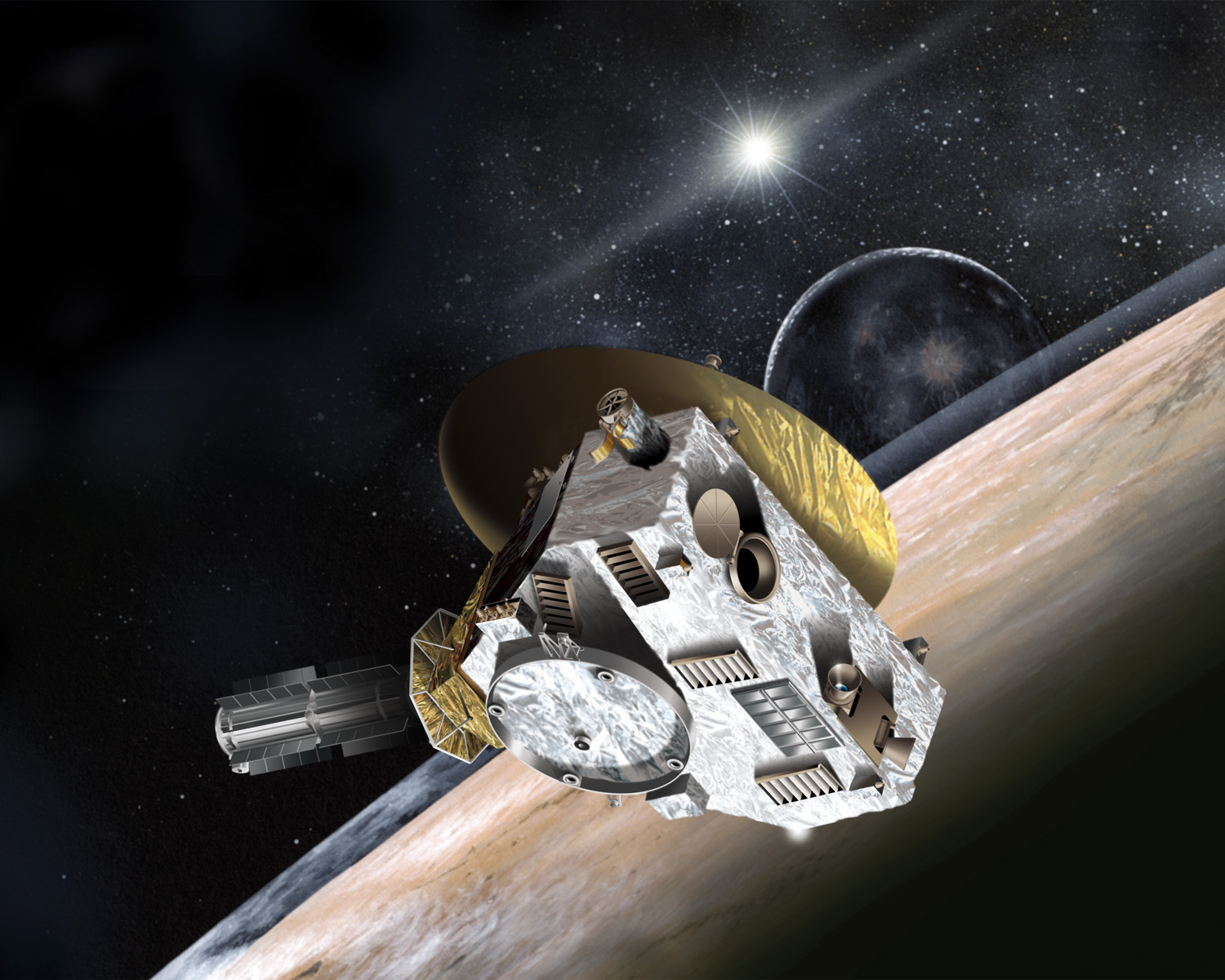
On the planner for Monday January 19, 2006 is a reminder of the fact that that is the date of the launch of the New Horizons Spacecraft that is destined to the be conveyor of our first real data about Pluto. After 9 years of travel through the solar system the spacecraft has begun its long awaited encounter with Pluto that will culminate in a fly-by on July 14 of the dwarf planet that lies 4.67 billion miles away from Earth.

List of space dates for Monday January 19
Now personally, I think that studying Pluto would be a slightly non-fulfilling job because it takes so long for spacecraft to get there. Think about it, when New Horizons launched, Pluto was still a full blown planet and had yet to be reclassified. If you really want to have things put in perspective, the iPhone wasn’t even a thing yet. We were still in the age of iPods with the clicking wheels (solitaire took forever!).

Artist's rendering of fly-by
Courtesy of nasa.gov
But those nine years of waiting are all going to be worth it starting January 25th, when the probe will commence a long range photo shoot of the dwarf planet. After 9 years of hibernation, the fastest spacecraft ever made has finally awoken in preparation for this historic moment. This photo shoot will mark the start of the first real collection of data about Pluto and its nearby moons. This data will, hopefully, provide valuable new insight into the makeup of Pluto and perhaps into the history of dwarf planets. It will also provide useful data in the effort to pinpoint the exact location of Pluto. Stay tuned for more on the data collected and the implications of it!

Sunday, January 11, 2015

Space Travel? YES. Affordable? Um.....YES!


Do you know how much it costs to send one pound of weight into space? Take a guess.
$100?
Not even close
$500?
Nope,
Alright? Maybe $1000?
Still off by a factor of ten
It costs $10,000 to send one pound into space!

Now if you really think about it that is a lot of money and material that gets used just for one launch. After all, you have to launch the entire first stage of the rocket that just gets burnt up in the atmosphere or dropped in the ocean. That is many $10,000 pounds that are only good for one launch. 

However, SpaceX is trying to change all that. They are the California based company started by Elon Musk that are responsible for the Dragon capsules that have completed five successful resupply missions for the ISS. 

On their latest mission to the ISS they tried something new: they tried to land the first stage of the Falcon rocket on a platform in the ocean so that it could be reused. Unfortunately there is no good video of the landing but Elon Musk's tweet sums up the situation well:

"Didn't get good landing/impact video. Pitch dark and foggy. Will piece it together from telemetry and ...actual pieces."
Autonomous spaceport drone ship
SpaceX Landing Platform just off the Cape
Courtesy of BBC.com
The landing was hard and caused damage to the platform and the ship itself. However, it is important to remember that in space exploration every new attempt is a success because of what is learned from it. 

This attempt to land undoubtedly taught SpaceX a lot of what they need to know in order to successfully complete the landing another time. Now improvements can be made and hopefully a future mission to land will be a success. 

Working technology to land the first stage of a rocket represents a whole new era in exploration that is marked by much more affordable and sustainable space travel. Right now space travel is a very costly (and worthwhile) venture and a more affordable way of going into space may be able to convince more people (especially more politicians) of the benefits and necessity of space travel. 

Saturday, January 3, 2015

Happy Perihelion!

Courtesy of nasa.gov
Tonight marks the point when the earth is closest to the sun. This is called perihelion from the Greek peri meaning near and hellos meaning sun. The moment this happens is at 06:36 UTC Jan. 4, 2015. That translates to 01:36 Eastern US time, or 10:36 p.m. Pacific time on Jan. 3 so technically it is tomorrow for part of the world but for us here in the Western US it is tonight (living on a sphere causes weird things to happen with time). 

As a moon orbits its planet, the planet moves, too.
Courtesy of nasa.gov
The earth orbits the sun in an elliptical path so our distance from the sun is always changing. If we orbited in a perfect circle, our average distance would never change. However, because the moon orbits the earth we actually move a little bit each day. You see, the moon is orbiting the earth but technically they are orbiting a common center of gravity (see animation).

Now perihelion is an interesting phenomena because it, when explained, debunks the myth that seasons happen because of the planet's distance from the sun. After all, it is winter in the Northern Hemisphere and yet we are as close to the sun as we get. Now the aforementioned myth is also easily debunked because it stems from Eurocentric or Northern Hemisphere-centric views. A lot of people forget that while it is winter in the Northern Hemisphere it is summer down south, so that myth does not hold up to logic. 

So as we approach perihelion remember how incredible it is that you are on a planet that is revolving around a star that is one of approximately 100 billion other stars in our galaxy. Puts things in perspective doesn't it?

I bid you a happy perihelion!

Wednesday, December 31, 2014

2014: The Space Year in Review

As 2014 comes to a close I invite you to join me in looking back over the most important things that happened in space exploration this year. Between the launch of Orion, the discovery of exoplanets,
and the landing of  a probe on a comet, it has been a busy year for space exploration!

Orion:
Orion Launch
Courtesy of  abcnews.com
On December 5, 2014 the Orion Space Capsule launched aboard a Delta IV Heavy Rocket from Cape Canaveral. It is a historic moment because it marks the start of the return of US based human space exploration. Orion is the capsule designed to send humans farther into space than ever before. It is planned to go to an asteroid and eventually to Mars. Missions like Orion will serve to reinvigorate the spirit for space exploration in the US and in the world.


Kepler:
Courtesy of wikipedia.com
This year the Kepler space telescope (read my post about it here) discovered 715 exoplanets. This is more planets than have ever been discovered. The discoveries serve to provide a goal for future space exploration: that someday we might visit on one of them. It also reminds everyone how incredible it is that we have life here and earth and sparks curiosity about whether life may exist on any of the countless exoplanets, both discovered and unknown.


Cosmos:
Courtesy of nerdist.com
This spring a revival of Carl Sagan's Cosmos: A Personal Voyage aired with a new title, new episodes and a new host. Even though this was not an event in space it is worthy of this list because it shared the wonders of space with over 400 million people in 60 different countries. It was hosted by Neil DeGrasse Tyson and it was amazing! If you did not get a chance to watch it on tv I highly recommend you take the time to watch it on Netflix, iTunes or Amazon; it will be time well spent.


Rosetta:
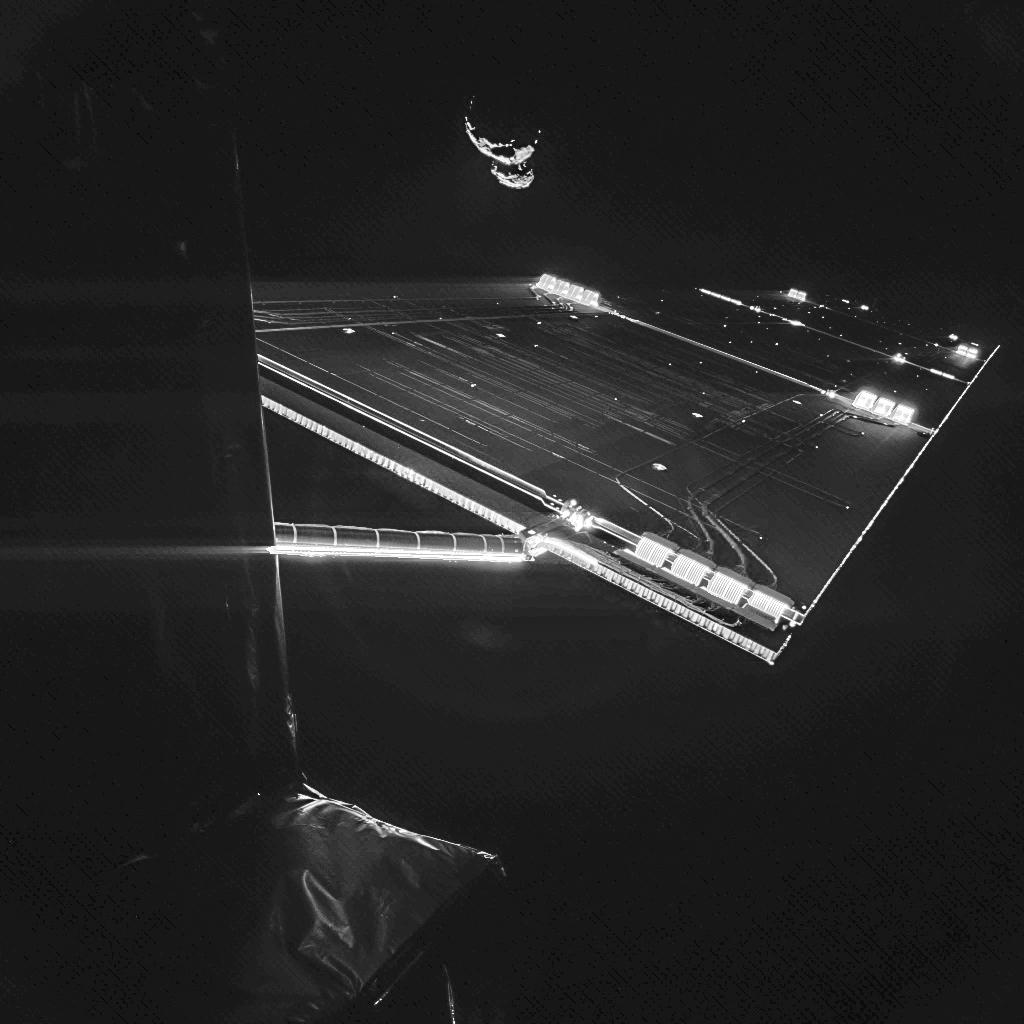
Rosetta's Selfie
Courtesy of esa.int
On November 12, 2014 the European Space Agency successfully landed a probe on Comet 67P/Churyumov-Gerasimenko (Don't worry, I can't pronounce that either). This in itself was a huge success that came after 10 years of travel by the spacecraft. It sent back lots of information about the comet along with pictures that are, to scientists, gold because they, for the first time ever, show what the surface of a comet actually looks like.

Unfortunately, the probe bounced and landed upside down in a crevice. While that is a problem as it cannot get power when it is in the dark, the mission was still a success. Landing on the comet was a huge leap for human space exploration and marks the start of a new era of exploration of comets and asteroids.


So, as you can see, a lot happened in space exploration this year. We learned a lot and had many successes. Let us hope that we can learn and explore even more in 2015!

Sunday, December 28, 2014

All About That.......SPACE!

I'm sure most of you have heard the song All About that Bass by Meghan Trainor. It has a catchy beat and has recently topped the charts. However, today I invite you to listen and watch what I would call a much improved version of the song:


Much better than the original, right? (No offense Meghan, but your's didn't talk about space exploration so it pales in comparison to this masterpiece).

This version was made by interns at NASA and is very similar to their parody of Gangnam Style. 
Videos like this are super because they connect popular culture and space exploration. Not to mention that the pictures are gorgeous and the video is just fun to watch. Can you imagine how much fun the interns must have had making that video? Best job ever! But really, wouldn't interning at NASA be AMAZING?!? I would love to have that opportunity some day. Because you know I'm all about that space, 'bout that space, space travel.

Thursday, August 14, 2014

Summer Exploration

A lot of people do interesting things during the summer but very few get to say that they directed a space shuttle mission, had lunch with an astronaut, and walked on the moon. That, however, is exactly what I got to do this summer. Well, not exactly. But I came as close as I could to doing every one of those activities while I was at Space Camp. Located in Huntsville, Alabama is the U.S. Space and Rocket Center. I attended the Advanced Space Academy there and left with my heart set on exploring the stars.
Upon arriving at camp we were separated into teams named after the fathers of rocket science. With those teams we participated in various interesting activities and seminars throughout the week. We began by wandering through the rocket park that is located there and learning all about the various machines that humans have launched into space. Gazing up at those rockets reminded me what an incredible technological feat space travel is and how impressive it is to say that we have put humans on the moon, have rovers on Mars, and even a ship, Voyager, that is in interstellar space. 
Throughout the week my team also participated in various classes to learn about the different systems aboard the ISS and the space shuttles. We filtered an unknown mixture to learn about the incredible filters that make life aboard the ISS possible. We also built model rockets with the hope of returning an egg (eggstronaut) to Earth without shattering. Additionally, we made shielding to try and protect the eggstronaut from heat to simulate the shields used to protect astronauts on reentry through Earth's atmosphere. I was fascinated by all of these activities as they taught me a lot about space travel even though I stayed firmly planted on Earth. 
Even though all the previously described activities were fun my absolute favorite part of Space Camp were the simulations. At the camp they have various machines to simulate parts of space travel. I rode in a centrifuge at three times Earth's gravity and bounced in a chair that simulates 1/6 of Earth's gravity, equivalent to the moon. Throughout the week my team and I took part in five different simulated missions to space. The U.S. Space and Rocket Center is equipped with a cavernous room full of mock space shuttles. There are also the various components of the ISS. In a room next door is Mission Control. During each mission I got to try a different position. I was shuttle commander, the ISS commander, the capsule communicator and, my favorite, flight director. I was stunned by how accurate these simulations were. Every switch, every button was designed to function like the real thing. We even got to wear flight suits for the missions so we felt very official. 
On my final day at camp I had one last incredible experience; I had lunch with an astronaut. I had previously signed up to be part of a group of around 30 people who got to hear astronaut Don Thomas speak about his four shuttle missions and what he believes to be important about space exploration. I asked Dr. Thomas what he thought the best thing is for my generation to do to revive the same enthusiasm for space exploration that existed during the Apollo age. His response was that we should talk about space travel and why it is important. To share with everyone the wonders that lie in the stars just waiting to be explored. I agree with him completely and think that one of the best places for a love of space to be cultivated is at Space Camp. There anyone and everyone can learn about the wonders and mysteries of the cosmos that are beckoning us to, in the words of Carl Sagan, leave the shores of earth behind and enter the cosmic ocean.

Thursday, February 20, 2014

Maybe Our World is Math

Recently I have thought a lot about how amazing math really is. I mean, how cool is it that equations and formulas like the Pythagorean Theorem will work every single time?!? I find that fascinating. As I was pursuing the part of Amazon.com for geeks like me that lists the variety of new science books I stumbled on one that I thought looked very intriguing. It is a very new, highly controversial book by Max Tegmark who is a professor of physics at MIT. The book is called Our Mathematical Universe.
Courtesy of amazon.com
It details his hypothesis about a universe that is not only described by mathematics but indeed is mathematics. I purchased the book and as I sit here writing this I have finished the first three chapters. I am very impressed by the clarity and concise nature of Tegmark's writing. Even though I have nothing more than a basic understanding of many of the mathematical principles he describes, I understand exactly what I am reading and furthermore, I find it to be incredibly interesting. I have yet to get into the meat of his proposal but as he explains the process by which the human race gained knowledge of the cosmos I am absolutely enthralled. It is books like this that have the power to inspire people to learn more about the incredible world we have the privilege to live in.

I truly believe that the awe that the universe inspires combined with the raw curiosity it sparks has the power to move mountains. (Not literally, of course) :).


Update 3/14/14: I have now finished this book and, if anything, my awe for the universe has increased. This book is a very dense but a very rewarding book. The ideas of it and the ideas behind his hypothesis are very interesting and it is guaranteed that I will need to spend some time mulling them over. To think about the idea that mathematical structures are the ultimate base of everything, is fascinating and it seems to make a lot of sense, at least with the evidence presented in the book.