Pages

Showing posts with label Earth. Show all posts

Sunday, February 15, 2015

25 Years of the Pale Blue Dot

The iconic Pale Blue Dot picture
Courtesy of wikipedia.org
Yesterday marks the 25th anniversary of the iconic Pale Blue Dot photograph taken by the Voyager 1 spacecraft. Carl Sagan is responsible for pushing NASA to turn the cameras of the ship back to earth. Carl Sagan is known as one of the most successful and diligent communicators of science and he is also one of my personal heroes. In honor of the anniversary of the picture I have decided to post a speech I gave about the 'cosmic perspective' which Carl Sagan shared with so many people in the world.


The cosmos is all that is, was, or ever will be. The word cosmos comes from the
ancient Greek term meaning order or world. For all the time that humans have walked
on this earth they have gazed up at the sky in wonder and down at the earth in
amazement in an attempt to understand the beauty of the order and logic of the cosmos
that surrounds us each and every day. Each tribe and group of the ancient past created
a way of attempting to find reason behind the workings of the world. They invented
stories like those of Greek mythology where each god correlated with a planet. Over the years
we, the human race, have lost contact with the cosmos. As we light up our world with
electricity and technology we spend more time looking down than we do looking up. We
have grown distant from the Cosmos. While the cultures of our ancestors were
intrinsically connected to the sky and the workings of nature our world has become
more and more self centered. We live in an individualistic culture where not much
thought is given to what else is out there or how valuable life here on earth is.
However, there still are people who do recognize how valuable our place in the
universe is and try to share that perspective with everyone because they recognize how
important that point of view is.
Dr. Carl Sagan
Courtesy of carlsaganday.com

Carl Sagan was a planetary scientist for NASA and a very successful popularizer
of science during his time on earth. Through his television show, Cosmos: A Personal Voyage,  he shared with over 600 million people in 60 different countries a hunger to understand our place in the universe and to understand why that position matters intellectually, culturally, and emotionally. He called this outlook on the universe “The Cosmic Perspective” and that is perspective is one I believe that we as humanity have lost and absolutely need to regain.

So what is this Cosmic Perspective? Well it is the understanding that the Earth is
a tiny mote of dust traveling around a medium sized star on a spiral arm of the Milky
Way galaxy with around 100 billion other stars in the galaxy which is only one of 100
billion other galaxies. Yet, the atoms that comprise life on earth were forged in the
center of a massive star. We, humans, are seemingly insignificant but very special at the
same time for we are the only Earth and one human race. To have a cosmic perspective
means having an understanding of how precious life in the cosmos is and how
important it is to understand what is around us.
Apollo 11 Moon Landing: One of the most iconic chapters of
US space exploration
Courtesy of nasa.gov

If one looks back through history it is very easy to
spot the people who had a cosmic
perspective. They were our ancestors who tried to find their place in the stars. They
were the scientists, the visionaries, the people who questioned why life exists and the
purpose of it. The people with the cosmic perspective were the ones who persistently
asked why even in the face of adversity. They were the explorers who searched to the
ends of the earth for new knowledge because they understood that a knowledge of
where we are in the cosmos is essential to the survival of the human race.
The urge to explore is something that has died away over the past few centuries
as we have settled and conquered most of the unknown places on earth. In the 1500’s
when the conquest of the America’s was in full bloom people traveled the world in
search of new and exotic places, people, and things. While part of the motive was
commerce there was also a raw search for knowledge. National spirit for exploration. Pride in knowing was out there.  And it is very obvious which countries held exploration at high value, they are the world superpowers today. However, that spirit for exploration and knowledge has died away. We are now a world that doesn’t look out or up. For the most part we look down. At our cell phones and our increasingly busy lives. We go about life without realizing that there is an infinite expanse of the cosmos just waiting for us to explore it. As Carl Sagan once said, “We sailed the earthly oceans but now it is time to step foot into the last unexplored area of human interests. We stand at the edge
of the cosmic ocean, just waiting to be explored.”

So how does one obtain a cosmic perspective? Well, the starting place is a
realization of the importance of the acquisition of knowledge. And how do we gain
knowledge? SCIENCE. Now when I say science I would not be surprised if what came
to mind are boring textbook readings, difficult labs, and a generally not good feeling. But
if that is what you believe is science, then your perception about science is off by 180
degrees. Science is everywhere and everything. Every time you ask a question and
figure out a way to answer it you are performing an experiment. You’re following the age
old scientific method. You’re gaining new knowledge about the cosmos and your place
in it and I believe there is nothing more important than that. Carl Sagan once said, “We
are a way for the cosmos to know itself.” By experimenting, questioning, and
researching we can push the boundaries of our knowledge and dare to have a cosmic
perspective and to learn about the cosmos that we inhabit and are also a deeply
connected part of.
Our cosmic address
Courtesy of nasa.gov
The second part of having a cosmic perspective is knowing our place in the
universe, our cosmic address. Let’s start with what we know. We are in the United States States of
America which is one of 196  countries on the planet Earth. Earth is located within the Solar System of 8 planets. That solar system is located on the edge of one of the spiral arms of the Milky Way. The Milky Way is located in the Local Group which is in turn each house at least 100 billion stars. Not to mention that many leading astronomers and astrophysicists believe that our universe may be only one of many. That we may live in a multiverse housing an infinite numbers of stars and galaxies. located in the Virgo Supercluster. Overall, there are over 100 billion galaxies in our observable universe that each contain an estimated 100 billion stars which have countless number of exoplanets around them.

Feeling small and insignificant yet? That’s okay. That’s part of having a cosmic
perspective. In the 1970’s Carl Sagan convinced NASA to turn the Voyager 1 spacecraft
around for one last glimpse of earth as it headed out into the cosmos. The picture is
famous for the perspective it gives. Saturn’s rings grace the foreground while one has to
really look for earth. In that picture our precious home planet, earth, is about the size of
a grain of sand, a pale blue dot. In all that vastness that surrounds our planet there is no
hint that help will come from elsewhere to save us from ourselves. Our imagined self-
importance, that we are somehow better than the rest is challenged by that pale point of
light. The Earth is the only known place with life. We are it. There is no other human
race. There comes a time in our lives when we realize that we as people, as a species,
as a planet are not the center of the universe and we come to value everything on this
speck of dust floating in the sky.


Carl Sagan saying it like it is
Courtesy of pintrest.com
It has been said that having the cosmic perspective is depressing but I think that
is incorrect. I think that to have a cosmic perspective is empowering because with it
comes a respect and appreciation for life itself. As Carl Sagan said, “Every one of us is,
in the cosmic perspective, precious. If a human disagrees with you, let him live. In a
hundred billion galaxies you will not find another. To me it underscores our responsibility
to deal more kindly with other humans and to protect and love the pale blue dot
because it is the only home we have ever known. If we take this knowledge to heart, if
we come to know our place in the cosmos and to love nature and our place in it then we
will be remembered as those who paved the way for the survival and bettering of the
human race.

Saturday, January 3, 2015

Happy Perihelion!

Courtesy of nasa.gov
Tonight marks the point when the earth is closest to the sun. This is called perihelion from the Greek peri meaning near and hellos meaning sun. The moment this happens is at 06:36 UTC Jan. 4, 2015. That translates to 01:36 Eastern US time, or 10:36 p.m. Pacific time on Jan. 3 so technically it is tomorrow for part of the world but for us here in the Western US it is tonight (living on a sphere causes weird things to happen with time). 

As a moon orbits its planet, the planet moves, too.
Courtesy of nasa.gov
The earth orbits the sun in an elliptical path so our distance from the sun is always changing. If we orbited in a perfect circle, our average distance would never change. However, because the moon orbits the earth we actually move a little bit each day. You see, the moon is orbiting the earth but technically they are orbiting a common center of gravity (see animation).

Now perihelion is an interesting phenomena because it, when explained, debunks the myth that seasons happen because of the planet's distance from the sun. After all, it is winter in the Northern Hemisphere and yet we are as close to the sun as we get. Now the aforementioned myth is also easily debunked because it stems from Eurocentric or Northern Hemisphere-centric views. A lot of people forget that while it is winter in the Northern Hemisphere it is summer down south, so that myth does not hold up to logic. 

So as we approach perihelion remember how incredible it is that you are on a planet that is revolving around a star that is one of approximately 100 billion other stars in our galaxy. Puts things in perspective doesn't it?

I bid you a happy perihelion!

Friday, May 24, 2013

The Universe is Infinitely Large and Getting Infinitely Larger

Reread that title and really think about it. After all infinite is really, really big and if infinite is getting bigger that is really, really, really BIG! Blows your mind right? I know that whenever I think about things like that I always walk away with a headache. Besides a headache, these trains of thought also leave me with a sense of awe about how incredibly large the universe is and how little and unimportant that makes me seem. You want to know why? Well, here goes.

The Earth has a circumference of 24,901 miles. The Earth is inside the solar system which is approximately 6 billion miles across. Feeling small yet? 

The solar system resides inside the Milky Way galaxy which is so big it has to be measured in light years. A light year is 587,849,981,000,000,000,000 miles. The Milky Way is 100,000 to 120,000 light years in diameter and contains 200 to 400 billion stars. Around the Milky Way are some 100 billion other galaxies!!! (Keep in mind that these numbers are only what we can see from Earth. There are probably lots more out there.) Now you should really feel small.
This is one 10 millionth of the night sky and all those spots are galaxies
Photo Courtesy of nasa.gov

As was previously mentioned the universe is getting infinitely larger. This means that as the universe expands we on Earth will see less and less of it. Future generations (a very long time from now) will look up in the sky and see absolutely nothing. You read that right. Absolutely. Nothing. 

Picture this: It’s a warm summer’s evening. You just had a barbecue with your family. You’re full and happy. The sun is just set so it is getting dark. You look up into the sky and see....nothing. Can you imagine that? Imagine how small and unimportant you would feel? Alone in the universe? 

But then you can look around you and see your family, your friends, and truly appreciate what you have. We can do the same thing with our multitudes of stars. Only when we look up into the sky, see all those stars, and take in the awe of the heavens can we really appreciate what we have here on Earth. 

To start off, we are alive. As far as we know we are the only ones alive in the universe. Then we can look around us and see the incredible people and places we are so lucky to have. I mean, just look around. The Earth is a magnificent place that is TOTALLY worth protecting. Think about the people who are most important in your life and remember how wonderful it is to have relationships with those around us. We are darn lucky to be human! So, let’s be happy to be who we are and never forget to fight for what we have because it is precious.

Friday, April 12, 2013

Asteroids, Astronomers, and........Birthdays?


Yup! Those three things constituted my Thursday. 

The first part of my day was the birthdays. While at school I got to celebrate my friend Micaela’s birthday. (She has a really awesome blog which is definitely worth checking out!) I then went to the Clark Planetarium’s Tenth Anniversary Gala to celebrate their tenth birthday.

The Clark Planetarium is one of my favorite places to go. They have a really fun gift shop, cool movies, and amazing interactives. While there I had the privilege of eating really good food, although, I had to harken back to the days when I played princess in order to remember how to go about using ten different pieces of silverware correctly. 

I then got to do something SUPER-DUPER cool! That is where the astronomers come in. I had the amazing privilege of meeting Dr. Philip Plait! That name may not mean a lot to you but in the world of astronomy he is well-known. Dr. Plait used to work for the NASA Goddard Space Flight Center on the Hubble Telescope. He is most well-known for his blog titled Bad Astronomy. It is a highly entertaining blog that debunks bogus astronomy. 

After meeting Dr. Plait we then got to listen to a lecture by him. He discussed one of the topics that is mentioned in his book, Death From The Skies. That is when the asteroid part of my evening took place. Death From The Skies is all about the ways that the universe can kill us. The first chapter of his book details the possibility of Earth being hit by asteroids and comets. Dr. Plait talked about the recent meteor explosion that occurred over Russia in 2012 on the same day that asteroid DA-14 passed us. He also showed some movie clips of astronomical objects colliding with Earth that came from Hollywood. He then showed us just how wrong they were scientifically. It was quite entertaining. 

Phil Plait introducing his lecture

To wrap up the evening there was a book signing where I got my (brand spanking new) copy of Death From The Skies signed. (See below) 
How cool is that?!?!?!

Overall, it was one of the coolest evenings of my life! I love being around people who share the same passion that I do for space. It will be hard to top that experience but I have something coming up next week that might just do it. Keep checking back to find out more....Bye!

Friday, November 9, 2012

We Are Not Going to Die (At Least Not on December 21)


The world is not going to end. Repeat, the world is not going to end. 

Last night I had the privilege to attend a presentation at the Clark Planetarium about the proposed end date for the world; December 21. The presentation was led by Dr. Peggy Cain. She discussed the myths and meanings of the origin of the doomsday legend.

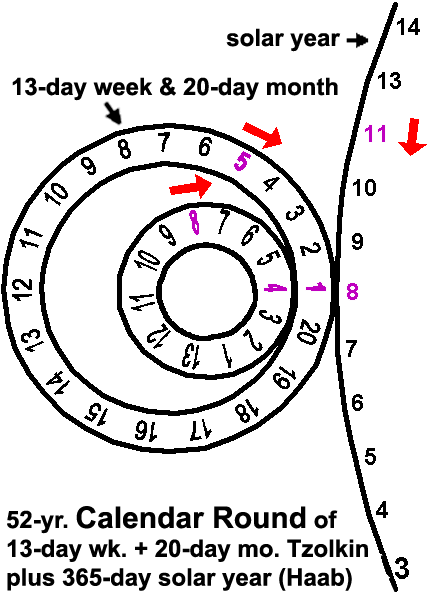
I learned that the Mayan culture is the origin of the legend about the end of the world. During the presentation Dr. Cain discussed how the Mayans have three calendars. The truly amazing thing about these calendars is that they are all based on astronomical phenomenons. This may not seem impressive in this day and age but the Mayan civilization began in 2000 B.C. so for them to have been able to calculate down to the day when things like the solstice would occur is truly incredible. 

The calendar that the ends on December 21 is the only linear calendar of the three. The other two are cyclical and constantly restart. 
This picture shows the concept of the two cyclical and one linear calendars of the Maya.
Photo courtesy of kalarhythms.org
The Mayan legend predicts that on this day the Great Rift, which is the band of the dust and plasma that can be seen in the sky at night, and the horizon will line up. It also says that the sun will be directly between us and the center of the galaxy. Some Mayans and others believe that on this day when this happens the door to the underworld will open up causing the apocalypse. 

Dr. Cain told us how the sun can never actually be between us and the center of the galaxy and that the Great Rift lines up with the horizon all the time.

Dr. Cain went on to discuss how all the scientific experts are debunking the myth. Places like NASA and National Geographic all agree that this legend is just myth.
Another thing that Dr. Cain went on to discuss is that the calendar that ends on December 21 will actually restart December 22, the same way our calendars do on January 1. 

I find that this whole idea of the world ending is very interesting and to be quite frank: slightly funny. The way the world has turned the concept of 2012 into a celebrity seems like a waste of time spent worrying. The cartoon below seems to sum it up to me. It’s all just a legend that can have significance for some people but does not mean the world will end.
A funny cartoon that sums up 2012 to me.
Photo courtesy of simplycreativewriting.com
We are all going to continue living on December 22. I do however think that perhaps we can look at this “doomsday” as a way to give thanks for life. Being able to live here on planet Earth every day is a gift and sometimes I think we forget how lucky we are. So when you wake up on December 22 take a moment to remember how cool it is to be alive! We live in a world full of possibilities and are fortunate to be here.

Friday, October 26, 2012

A Next Door Neighbor


Earth.

Home to seven billion people.

Unique in size to all the other planets.

All alone.

Wait! What do you mean it now has a neighbor?

An Artist's Rendition of the New Planet.
Photo Courtesy of Nytimes.com
That’s right. On Wednesday of this week a team of European astronomers announced the discovery of a new planet. Great, another planet to learn about. Go stick it on the shelf next to ALL the other new planets. However, this planet is special. It is Earth-sized and relatively speaking, very close to us. It lies in the orbit of Alpha Centauri which is the closest star to us. Only 4.3 light years away! (That’s eighty-one thousand years in our fastest spaceship)

Scientists, astronomers, and  astrophysicists all around the world are very excited about this discovery because this new planet, which is currently unnamed, is so close to Earth and is not exponentially smaller or larger than Earth.

Imagine how this could affect us here on Earth. For starters, if there is one there are more. Even though this one is rocky and it’s closeness to Alpha Centauri causes temperatures that are unlivable there most likely are other ones out there that may be the right distance away from their sun that there would be livable conditions. There could even be a planet out there with life on it.

One small planet can make so many differences in our life. There is now discussion of having telescopes focus specifically on that area of the galaxy and, if they find more planets of similar size, sending a probe there!

I was so excited to hear about this because I firmly believe that there is other intelligent life somewhere in our universe and I think that this discovery has sparked new flames to work harder and dig deeper on our way to finding life. I also think that this is such an important discovery simply because of the fact that we were able to see it. The planet is 4.3 LIGHT YEARS away. That is 25,277,000,000,000 miles away. To know that we can find planets that far away and be able to tell things about them like what their surface is made of never fails to astound me. 

This new little planet means the start of a new era of space exploration. A search to find other Earth-like planets. Who knows what this has is store? I sure don’t but I am very excited to find out!