Pages

Showing posts with label Exploration. Show all posts

Wednesday, March 11, 2015

Actually, It Is Rocket Science

Get up at 5:15, drive for 2 hours, why? To go see a rocket test, of course! Today I had one of the most amazing experiences of my life: I got to see the first test of the solid rocket booster (SRB) for NASA's new Space Launch System (SLS). The test was at Orbital ATK in Promontory, Utah and my, oh, my was it incredible! 

The test was the first test of the new booster, the most powerful ever built and successfully fired. There will be one more certifying test for the booster before two of them will be attached to the core stage and used to lift the Orion Crew Vehicle into space. The initial life capability of two of these boosters working in tandem will be 70-130 metric tons. The booster burned 5 tons of propellant per second and in total produced 3.6 million pounds of thrust in the two minutes it was fired. 

Comparison of SLS to other rockets
Courtesy of nasa.gov

Because the SLS is going to be launching heavier payloads than any rocket system before it, there needs to be more thrust. To accomplish this there was another section added to the booster making it a five section, 177 foot (17 story) tall contraption. The SLS booster generates 20% greater average thrust than the SRBs on the Space Transportation System (Space Shuttle) and has 24% greater total impulse. 

This test was a particularly awesome moment to be present for because it represents the start of a new era in space exploration. To stand and see the fireball shoot out the end and then feel the ground shake as the sound and shock waves hit, was a breathtaking experience.
In that video you can hear/see the difference in time between when the booster was ignited (FUN FACT: Once SRB's are ignited there is no off switch. They burn till the very end). Keep in mind that it was that bright and that loud from 2 miles away! (We did the calculations to determine that in the car ride home because we're cool like that) 

Today was one of the most unforgettable moments of my life. It was so incredible to be a witness to the new era of space exploration. As my friend so eloquently put it, "May this be not a once in a lifetime, but a first in a lifetime."

Sunday, February 8, 2015

Space X Landing Round 2

Today Space X will attempt to land its Falcon 9 rocket on its sea based landing pad for the second time. They tried a few weeks ago unsuccessfully. The success of reusable rockets would mark the start of a new era in space exploration. It would indicate a shift to more cost effective space programs that are also more environmentally friendly and sustainable.
Space X landing pad
Courtesy of spacex.com 
The launch is scheduled for 6:10 EST. Coverage starts on NASA TV at 3:30 EST. Be sure to check in before going to watch Taylor Swift kill it at the Grammy's! 

May the force be with you Space X!

Wednesday, December 31, 2014

2014: The Space Year in Review

As 2014 comes to a close I invite you to join me in looking back over the most important things that happened in space exploration this year. Between the launch of Orion, the discovery of exoplanets,
and the landing of  a probe on a comet, it has been a busy year for space exploration!

Orion:
Orion Launch
Courtesy of  abcnews.com
On December 5, 2014 the Orion Space Capsule launched aboard a Delta IV Heavy Rocket from Cape Canaveral. It is a historic moment because it marks the start of the return of US based human space exploration. Orion is the capsule designed to send humans farther into space than ever before. It is planned to go to an asteroid and eventually to Mars. Missions like Orion will serve to reinvigorate the spirit for space exploration in the US and in the world.


Kepler:
Courtesy of wikipedia.com
This year the Kepler space telescope (read my post about it here) discovered 715 exoplanets. This is more planets than have ever been discovered. The discoveries serve to provide a goal for future space exploration: that someday we might visit on one of them. It also reminds everyone how incredible it is that we have life here and earth and sparks curiosity about whether life may exist on any of the countless exoplanets, both discovered and unknown.


Cosmos:
Courtesy of nerdist.com
This spring a revival of Carl Sagan's Cosmos: A Personal Voyage aired with a new title, new episodes and a new host. Even though this was not an event in space it is worthy of this list because it shared the wonders of space with over 400 million people in 60 different countries. It was hosted by Neil DeGrasse Tyson and it was amazing! If you did not get a chance to watch it on tv I highly recommend you take the time to watch it on Netflix, iTunes or Amazon; it will be time well spent.


Rosetta:
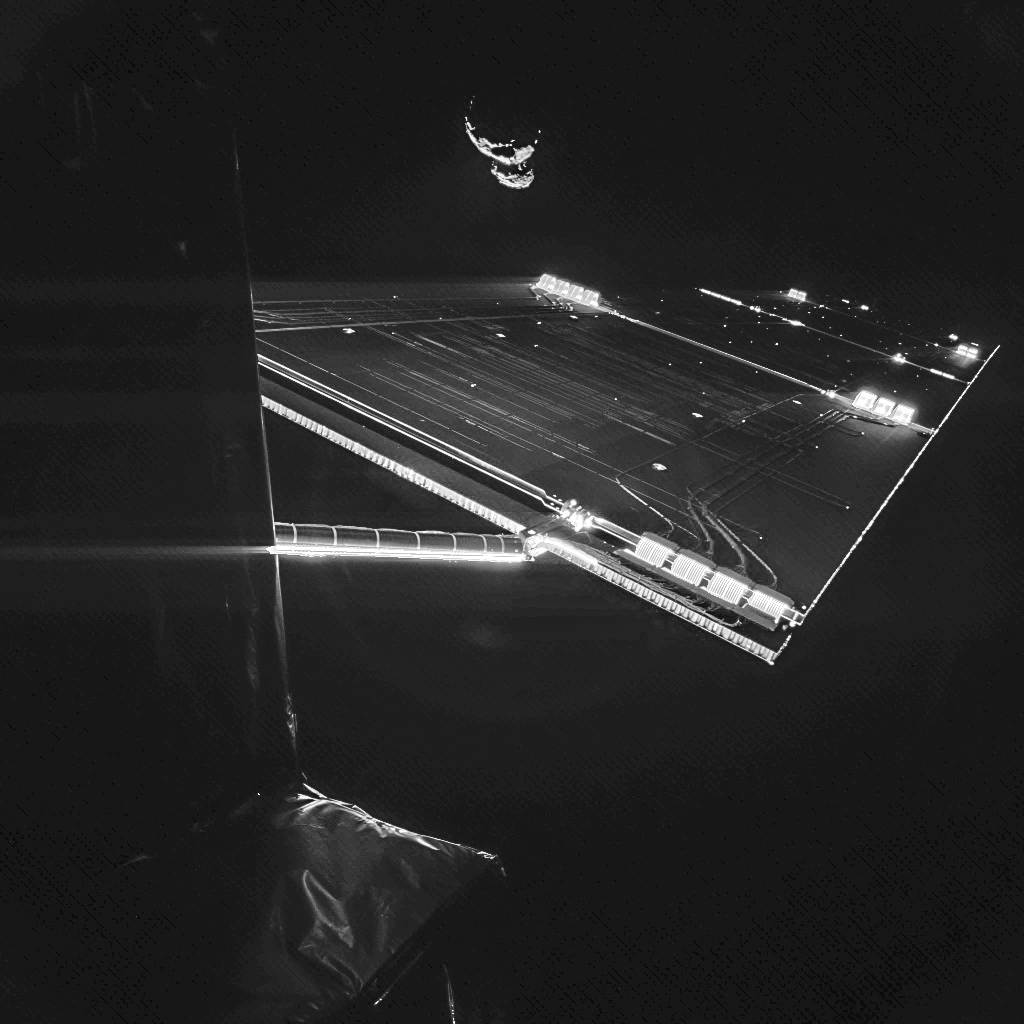
Rosetta's Selfie
Courtesy of esa.int
On November 12, 2014 the European Space Agency successfully landed a probe on Comet 67P/Churyumov-Gerasimenko (Don't worry, I can't pronounce that either). This in itself was a huge success that came after 10 years of travel by the spacecraft. It sent back lots of information about the comet along with pictures that are, to scientists, gold because they, for the first time ever, show what the surface of a comet actually looks like.

Unfortunately, the probe bounced and landed upside down in a crevice. While that is a problem as it cannot get power when it is in the dark, the mission was still a success. Landing on the comet was a huge leap for human space exploration and marks the start of a new era of exploration of comets and asteroids.


So, as you can see, a lot happened in space exploration this year. We learned a lot and had many successes. Let us hope that we can learn and explore even more in 2015!

Thursday, August 14, 2014

Summer Exploration

A lot of people do interesting things during the summer but very few get to say that they directed a space shuttle mission, had lunch with an astronaut, and walked on the moon. That, however, is exactly what I got to do this summer. Well, not exactly. But I came as close as I could to doing every one of those activities while I was at Space Camp. Located in Huntsville, Alabama is the U.S. Space and Rocket Center. I attended the Advanced Space Academy there and left with my heart set on exploring the stars.
Upon arriving at camp we were separated into teams named after the fathers of rocket science. With those teams we participated in various interesting activities and seminars throughout the week. We began by wandering through the rocket park that is located there and learning all about the various machines that humans have launched into space. Gazing up at those rockets reminded me what an incredible technological feat space travel is and how impressive it is to say that we have put humans on the moon, have rovers on Mars, and even a ship, Voyager, that is in interstellar space. 
Throughout the week my team also participated in various classes to learn about the different systems aboard the ISS and the space shuttles. We filtered an unknown mixture to learn about the incredible filters that make life aboard the ISS possible. We also built model rockets with the hope of returning an egg (eggstronaut) to Earth without shattering. Additionally, we made shielding to try and protect the eggstronaut from heat to simulate the shields used to protect astronauts on reentry through Earth's atmosphere. I was fascinated by all of these activities as they taught me a lot about space travel even though I stayed firmly planted on Earth. 
Even though all the previously described activities were fun my absolute favorite part of Space Camp were the simulations. At the camp they have various machines to simulate parts of space travel. I rode in a centrifuge at three times Earth's gravity and bounced in a chair that simulates 1/6 of Earth's gravity, equivalent to the moon. Throughout the week my team and I took part in five different simulated missions to space. The U.S. Space and Rocket Center is equipped with a cavernous room full of mock space shuttles. There are also the various components of the ISS. In a room next door is Mission Control. During each mission I got to try a different position. I was shuttle commander, the ISS commander, the capsule communicator and, my favorite, flight director. I was stunned by how accurate these simulations were. Every switch, every button was designed to function like the real thing. We even got to wear flight suits for the missions so we felt very official. 
On my final day at camp I had one last incredible experience; I had lunch with an astronaut. I had previously signed up to be part of a group of around 30 people who got to hear astronaut Don Thomas speak about his four shuttle missions and what he believes to be important about space exploration. I asked Dr. Thomas what he thought the best thing is for my generation to do to revive the same enthusiasm for space exploration that existed during the Apollo age. His response was that we should talk about space travel and why it is important. To share with everyone the wonders that lie in the stars just waiting to be explored. I agree with him completely and think that one of the best places for a love of space to be cultivated is at Space Camp. There anyone and everyone can learn about the wonders and mysteries of the cosmos that are beckoning us to, in the words of Carl Sagan, leave the shores of earth behind and enter the cosmic ocean.

Thursday, January 16, 2014

The Most Inspiring Thing In The Universe

I've been doing a lot of reading and thinking about space recently and have reached a solid conclusion. The most inspiring thing in the universe is the universe itself. After all, when looking back through history nothing has made all of humanity more excited and interested than exploration. Who are the people that fifth graders have to memorize the name of? The European explorers of the Americas. What rallied an entire nation and even a world in the mid 1900's? The Race to Space! As Vincent Van Gogh once said, 

"For my part I know nothing with any certainty, but the site of the stars makes me dream."

I find that to be such a true statement. When I look up at the sky and see the light of stars that has traveled many light years to reach my retinas, I see the world in a much clearer reality. Everything seems to be put in perspective. That perspective inspires me to go forth into the world and really do what makes me happy and what helps the world. 

Based on that, I have decided to start blogging again. I love the chance that this blog offers me to share my passion with the world. Nothing makes me smile more and feel more productive than talking about the wonders and the workings of the universe and how they are part of everyone's everyday lives. 

Friday, May 24, 2013

The Universe is Infinitely Large and Getting Infinitely Larger

Reread that title and really think about it. After all infinite is really, really big and if infinite is getting bigger that is really, really, really BIG! Blows your mind right? I know that whenever I think about things like that I always walk away with a headache. Besides a headache, these trains of thought also leave me with a sense of awe about how incredibly large the universe is and how little and unimportant that makes me seem. You want to know why? Well, here goes.

The Earth has a circumference of 24,901 miles. The Earth is inside the solar system which is approximately 6 billion miles across. Feeling small yet? 

The solar system resides inside the Milky Way galaxy which is so big it has to be measured in light years. A light year is 587,849,981,000,000,000,000 miles. The Milky Way is 100,000 to 120,000 light years in diameter and contains 200 to 400 billion stars. Around the Milky Way are some 100 billion other galaxies!!! (Keep in mind that these numbers are only what we can see from Earth. There are probably lots more out there.) Now you should really feel small.
This is one 10 millionth of the night sky and all those spots are galaxies
Photo Courtesy of nasa.gov

As was previously mentioned the universe is getting infinitely larger. This means that as the universe expands we on Earth will see less and less of it. Future generations (a very long time from now) will look up in the sky and see absolutely nothing. You read that right. Absolutely. Nothing. 

Picture this: It’s a warm summer’s evening. You just had a barbecue with your family. You’re full and happy. The sun is just set so it is getting dark. You look up into the sky and see....nothing. Can you imagine that? Imagine how small and unimportant you would feel? Alone in the universe? 

But then you can look around you and see your family, your friends, and truly appreciate what you have. We can do the same thing with our multitudes of stars. Only when we look up into the sky, see all those stars, and take in the awe of the heavens can we really appreciate what we have here on Earth. 

To start off, we are alive. As far as we know we are the only ones alive in the universe. Then we can look around us and see the incredible people and places we are so lucky to have. I mean, just look around. The Earth is a magnificent place that is TOTALLY worth protecting. Think about the people who are most important in your life and remember how wonderful it is to have relationships with those around us. We are darn lucky to be human! So, let’s be happy to be who we are and never forget to fight for what we have because it is precious.

Friday, May 10, 2013

A One Way Trip To Mars? No Thanks


There are 78,000 people applying to be aboard a one way trip to Mars. The trip is sponsored by the a group called Mars One. Their goal is to put a permanent human settlement on Mars. They want the first four people to be on Mars by 2023.

For me personally I think this project is not a very good idea. I think that while the populous should be involved in space exploration we need to leave the engineering and carrying out of the projects to space agencies who have experience and protocol. 

From the start of space exploration our space agencies around the world have learned what needs to be done to keep human life safe in space. Also, we have protocol for not bringing things such as viruses and bacteria from Earth out into space. From the moment a human sets foot on Mars it will be contaminated and could potentially kill any forms of life that may exist there.I also think that the space exploration should be a public and publicly funded endeavor. It needs to be of the people. Private enterprise is great for some things but not space exploration.

Proposed Mars Colony
Courtesy of space.com
Another obvious fault with the plans of Mars One is the why. Our robotic technology gets better everyday. So why spend over four billion dollars to put a human on Mars and endanger their life and potential extraterrestrial life forms? A robot can do scientific observation faster and more effectively than a human when it comes to researching Mars. I’m not saying the spark of human curiosity is not extremely valuable. I’m saying that for right now robots are the way to go.

Also, Mars is a very toxic environment for a human. One little error can cause drastic failure and death. Until we have a really good reason to put humans on Mars and until we have a way to bring them home let’s wait. 

Overall I admire the initiative of Mars One but I don’t think it is the way to go right now.

So then I must ask, what do you think?

Thursday, May 2, 2013

Rocket Science For Dummies


I admit it. Despite having a blog all about space I actually know very little about the actual mechanics of space. That is why I am on a never ending quest to learn as much as I can about space and the mysteries it holds. I’m proud to say that Neil Degrasse Tyson’s Death By Black Hole was the first non-fiction book I ever finished of my own free will. The reason I finished it? It was fascinating!! Who knew that there are creatures who can survive at -328 degrees F? Or that the reason the ultra-violet radiation from the sun is bad for you is because it is literally decomposing your skin? Learning about space is really fun and I think that is because it is unlike what one hears in their everyday life. 
Funny Poster
Courtesy of zazzle.com

When I sit down to read one of my many, many, many, many space related books I can never put them down. The topics fascinate me. Right now I am reading about parallel worlds. How cool is that? Did you know that there could be another one of you and me in a parallel world? And that’s not science fiction? 

Now this post is all about rocket science. Rocket science is the how. How do we get a rocket into space? How do we put a lander on the moon or on Mars.  How? How? How? That is what rocket scientists do. They design the crafts that leave earth’s atmosphere and go exploring. They are the explorers of tomorrow because they are exploring the one place humans haven’t gone all over, space. Humans are explorers by nature. We are curious and that, for the most part, is a good thing. That is why rocket science is so cool! They design the crafts that will go “where no man (ahem, human) has gone before.”

Now, I can’t teach you all about the astrophysics of rocket science because I am not an astronautical engineer, (which, by the way, is the technical name for a rocket scientist) but what I can do is give you links to some of my all time favorite space books that have taught me about space. 

Emma’s Favorite Space Books:

By Neil DeGrasse Tyson


By Neil DeGrasse Tyson

By Brian Greene

By Michio Kaku

Friday, March 29, 2013

Star Trek vs. Science

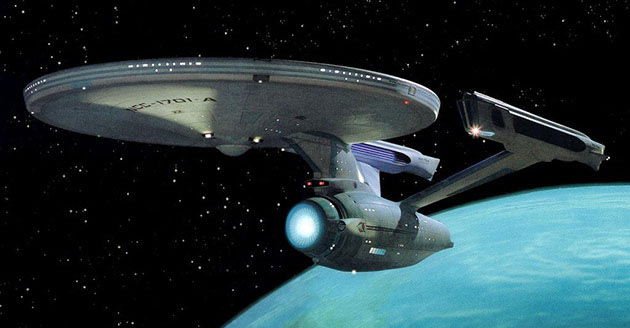
Star Trek Enterprise
Photo Courtesy of news.yahoo.com

Announcing the battle of the eon! It’s the devices and physics in Star Trek versus the hard, facts of science. Who will win? Well, the science battle of a lifetime is coming up next. I am about to pit the devices and concepts of Star Trek 

against the realities of science. Up first....


The Tricoder


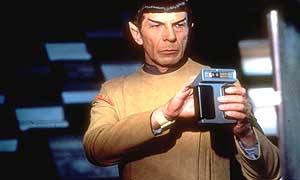
Spock with tricorder
Photo Courtesy of guardian.co.uk
In Star Trek the doctor and other members of the landing parties would often carry a device called a tricorder. A tricorder is a device that when scanned over a person’s body can tell you all about their vital signs and chemical composition. It can also tell various features about the surrounding landscape.

                                                                 Versus 

Science

The tricorder has a lot of potential. There are lots people who think that a device similar to a tricorder is the the future of healthcare. Because of the popularity of the concept there are lots of people who are aiming to create one. The X-Prize Foundation is offering prizes totaling 12.5 million for a functioning tricorder. Also there is the Tricorder Project. The Tricorder Project was started by a man named Peter Jansen. He designed a device similar to the tricorder and then gave the instructions out to the public so that all could make one. Overall, the tricorder holds lots of promise for the medical world and is a pretty realistic concept.


Warp Drive

In Star Trek whenever they need to travel far distances across space the captain will command that the warp drive be engaged. They then speed across the universe faster than the speed of light.

                                                                  Versus 

Science

Many of you are probably thinking that there is no way warp drive could ever be possible. You may just be wrong. There are many physicists who are working on a way to bend the fabric of space-time and move faster than the speed of light. They propose using a device that the astronauts would sit inside that would create a bubble in space-time. 

Proposed space "bubble"
Photo Courtesy of space.com

The astronauts inside the bubble would not feel anything different. The space in front of the ship would be expanding and the part in back contracting which would move the ship forward. So even though warp drive is currently theoretical it could become an actuality.

And the winner is.....well, really neither science nor Star Trek can win this battle. What can be said is that the future of space travel holds wonderful possibilities and the devices from Star Trek may be very helpful along the way. We can also say that when Gene Rodenberry created Star Trek he was very creative but also surprisingly realistic. I bid you farewell today with the classic Star Trek goodbye.

Live long and prosper

Friday, March 22, 2013

What Do Invisible Braces, Cordless Tools, Water Filters, and Memory Foam Have in Common?

The answer to that question: They are all a direct result of NASA.

Invisible Braces:

I’ve had braces and believe me, it is not fun. Many people dread braces because they do not want to have their mouths be full of metal for 1.5-2 years. For some teens the solution to that problem is convincing their parents to let them get invisible braces. If it were not for NASA, they would not be able to do that. The material used to make invisible braces is called translucent polycrystalline alumina (TPA) and was designed by NASA Advanced Ceramics Research. TPA was originally designed for protection of the infrared antennae of heat-seeking missile trackers and now it is in your mouth.

Cordless Tools:

Have you ever used a drill to hang something up? Chances are that the drill probably was cordless. You can thank NASA for that. Cordless tools were first designed in preparation for the Apollo missions. 
Cordless Drill
Courtesy of amazon.com

The idea was that people on the moon could drill for samples but no have to go through the hassle of plugging in a cord while on the moon. The drill had to be powerful yet lightweight. Black & Decker worked with NASA to design such a tool and now you can find cordless tools all over.

Water Filters:

Do you drink water? I hope so because if the answer is no then you are dead or soon will be. Now you can drink water and that’s fine and dandy but for it to be really helpful the water has to be clean. The most common way to make sure that your water is clean is to filter it. 
Charcoal Filter
Photo Courtesy of www.bedbathandbeyond.com

The design for the filter came from, you guessed it, NASA! When the preparation for the Apollo missions was occurring NASA needed to design a way to make sure that the water astronauts in space were drinking was safe. They did so by designing the charcoal filter. If you go look at the filter for your water, it is most likely that same kind. Thank you NASA!

Memory Foam:

It’s nighttime, you crawl into your nice memory foam bed. Oh, it’s comfy! Who can you thank for it? NASA, of course. The polyurethane-silicon plastic used to make memory foam beds was originally designed to lessen impact during landings of spacecraft. The ability of the foam to distribute weight and pressure provides large amounts of shock absorbency.

These are just a few of many devices and innovations that NASA has contributed to our everyday lives. So if you ever think that science is not in your everyday life, think again. Science, particularly that of NASA, is everywhere!

Friday, March 15, 2013

Houston We Have......Life?


Picture this: It’s Wednesday morning. I glance at the paper that’s sitting on the table, see the usual boring headlines and turn away. As I begin to walk away I do a double-take and come rushing back to the newspaper. Something about life and Mars? 

Yes, that is what many people saw this week when they looked at or watched the news. 


On March 12, 2013 NASA’s Jet Propulsion Laboratory received data from a sample analysis done by SAM on the Curiosity Rover. (For more about the tools on Curiosity and how they work check out my post on Curiosity) The analysis was performed on a piece of Martian rock. It contained sulfur, nitrogen, hydrogen, oxygen and phosphorus. All of those are key ingredients for there to be life. 

Curiosity Rover Self Portrait
Photo Courtesy of space.com

One of the key reasons why there is still so much research being done on Mars is because scientists and the public alike want to know if Mars ever supported life forms. This report suggests that the answer to that question is yes. The sample analysis also showed possible pairings of chemicals that could suggest a chemical energy source for micro-organisms to thrive on. NASA is planning to have the Curiosity Rover test another sample to verify the results.

This is such a huge deal for so many reasons. Many people all around the world have speculated as to whether life ever could have existed elsewhere, but especially on Mars. The red planet has always been a prime candidate for the possibility of the previous existence of life but this new data suggests that it almost positively did. 

Imagine what this could mean! If the second test comes back from Curiosity with the same results then we could be very sure that there was life elsewhere than Earth. Many people have speculated that we are not alone. After all the probability that we are the only life in a universe that is constantly expanding and goes on infinitely, is very small. These results could spur a larger, more expansive search for life elsewhere in the universe. Which, of course, is very exciting.

Also, I think that we do have to take into consideration why there no longer is life on Mars. (If there ever was) I suggest that we look at the data from Curiosity with a thoughtful eye and make sure that our own very precious Earth does not someday end up as a big burned up planet with an atmosphere of carbon dioxide similar to that of Mars.

Looking at this incredible new information from Curiosity is an amazing opportunity that I think opens up a new part of space exploration. I also think that it raises lots of questions. I hope that as you close out of this blog and lay down this evening that you think about the fact that you live in a universe that is full of undiscovered things and that you ask yourself what you the possibility of other life means to you.

Thursday, February 28, 2013

Thor’s Hammer Weighs As Much As 300 Billion Elephants


That was the measurement that astrophysicist Neil DeGrasse Tyson came to when he began to calculate the weight of the hammer that the Marvel superhero wields. Besides being able to calculate random things like the weight of a hammer and find Superman’s home planet, Neil DeGrasse Tyson also has contributed lots of valuable knowledge and literature to the world of astrophysics.

Neil DeGrasse Tyson
Photo Courtesy of haydenplanetarium.org
Dr. Tyson is the director of the Hayden Planetarium. He is also an author of many wonderful  books. I just finished reading Death By Black Hole which is the first non-fiction book I have been able to complete. It is a wonderful collection of essays about different phenomena's in the universe. 

I admire Neil DeGrasse because he has many wonderful quotes. One of my favorites is-

“One thing is for certain, the more profoundly baffled you have
been in your life, the more open your mind becomes to new ideas.”
- Death By Black Hole pg. 305

I love this quote because I think it is perfectly true. I know from personal experience that when I am baffled I learn the most and that what I learn after being baffled is what sticks with me into the future. Another one of my favorite quotes is-

“A common way to compute density is, of course, to take the ratio of 
an object's mass to its volume. But other types of densities exist, 
such as the resistance of somebody's brain to the imparting of 
common sense.”- Death By Black Hole pg. 135

I love this quote because it makes me laugh and because I have had experience with people who have a resistance to the imparting of common sense. 

Another reason that Neil DeGrasse Tyson is so amazing is because he has the coolest job ever. He is an astrophysicist. The word astrophysics tends to scare people away but it really isn’t that scary. If you break the word apart it becomes astro and physics. Astro basically means “pertaining to the universe.” Physics is the study of why things work and occur the way the do. So astrophysics is the study of how and why things work the way they do in the universe. How cool is that?!

It is no coincidence that I wrote about Neil DeGrasse Tyson today. I just placed in the mailbox a letter to him that happened to contain the URL of my blog. So, if Dr. Tyson you are reading this now I want you to know that I think that what you do is amazing and that I look up to you!

Sunday, February 24, 2013

3.....2.....1.....Blast Off!!!!


“We have liftoff!” are the words that NASA and SpaceX officials hope to hear on March 1, 2013 when the Dragon Space Capsules is once again launched into space. The mission will be the same as the previous missions of the capsule: to resupply the International Space Station. The capsule will launch from the SpaceX launch complex at the Cape Canaveral Air Force Station in Florida. This flight will be another in a string of missions by SpaceX and their Dragon Capsule. 

SpaceX was founded in 2002 by Elon Musk who is the co-founder of PayPal and the owner and founder of Tesla Motors. The company has had many historic firsts. SpaceX was able to put the first privately developed liquid-fueled rocket in orbit around Earth. They are also the first company that has been able to successfully put a vehicle in space and retrieve it intact. On May 25, 2012 SpaceX reached a big milestone. The company became the first to have one of their commercial vehicles go to space, attach to the International Space Station, deliver cargo, and return to Earth. These accomplishments are impressive because they symbolize the start of private space travel. They show a future where government agencies and private companies will work together to advance spaceflight exponentially. SpaceX currently holds a contract with NASA where they are set with designing a spacecraft to carry humans into space. For more information about SpaceX click here.

Dragon Space Capsule after return to Earth
Photo Courtesy of spacex.com

The Dragon Space Capsule is the star jewel of SpaceX. This vehicle has been able to go on successful, record-breaking missions which have proved the companies worth. One really cool, very helpful and extremely cost-effective feature of this spacecraft is it’s ability to be reused. It was designed so that it could be landed in the ocean and then recovered. After recovery it is rebuffed and can be used again. The spacecraft is launched into space on a Falcon 9 rocket which is also designed by SpaceX. 

Falcon 9 rocket carrying a Dragon Capsule
Photo Courtesy of spacex.com
This Friday another launch of the Dragon Capsule is set to occur. As previously mentioned it will take off in Florida. It will then meet with the International Space Station and deliver cargo. The capsule is set to return to Earth on March, 25 with a big SPLASH into the Pacific Ocean near Baja, California. It will be carrying back experiments and supplies that the ISS no longer needs. Keep your eye on the news to see if the capsule arrives safely and if you are on a boat in the Pacific watch out! No one needs to get bonked on the head by a runaway capsule.

Thursday, January 3, 2013

2012: The Space Year in Review


Before we dive into 2013 I think it is important to look back at all the amazing accomplishments that have occurred in 2012. This year has been a big one for discoveries in space and one full of milestones regarding people and ships who have traveled there. There have been well-known astronauts who passed away, new rovers sent out to discover, and new companies pushing the boundaries of space.


Photo Courtesy of nasa.gov
Neil Armstrong

August 5, 1930- August 25, 2012

This year the nation and world were saddened to hear that Neil Armstrong had passed away. Neil Armstrong was the first human being to ever touch another planet while in space. He is most well known for his quote, “One small step for a man, one giant leap for mankind.” Throughout his life he pushed barriers and inspired other people to reach for the stars.


Photo Courtesy of nasa.gov
Curiosity Rover

On August 6, 2012 the Curiosity rover touched down on Mars. This was a game changing event for the United States and the entire world since the Curiosity rover carries the most advanced scientific research tools ever present on Martian soil. The discoveries that it has made and the discoveries that it will make are and will be influential for the future of space flight.

If you are interested in learning more about the Curiosity rover click here.


Photo Courtesy of wikipedia.org
Sally Ride

May 26, 1951- July 23, 2012

The world was saddened this year when they had to say goodbye to Sally K. Ride. She was the first female astronaut in space. Sally Ride lead the way for young women who were/are interested in going into space. She had a Ph.D. in physics and was inducted into the National Women’s Hall of Fame and the Astronaut’s Hall of Fame. Sally Ride will never be forgotten for the barriers she broke down and the doors she opened up.


Photo Courtesy of wikipedia.org
SpaceX

This year SpaceX became the first commercial company to send their own space vehicle to the International Space Station. It sent its second Dragon capsule to the ISS where it docked and gave the station supplies. This is/was big news because it opens up space travel to private companies. That can mean that in the near future there will be  trips to space for the non-astronaut person and eventually even hotels and colonies.


I have already done a post about the Curiosity rover but intend to do individual posts about each of these topics so keep checking the blog for the latest posts!

Also, I would love to here what you want to see a post about! As long as it has to do with space I would be happy to try. If you have an idea leave it in the comments and I will try my hardest to do one a post about it.

Friday, December 14, 2012

All About Kepler


Have you ever heard of William Borucki? I hadn’t until I read the latest issue of Discover magazine. They had a whole article dedicated to him and his project. William is the man behind Kepler. Kepler is the planet-finding telescope that is looking for Earth-like worlds within the Milky Way galaxy. As you probably know already from my other posts, I like the idea of finding other Earth-like planets because they have the potential for life. That is why this article was really interesting to me. 

The story talks about how since the launch in 2009 Kepler has found over 3,000 potential planets and counting. This is super amazing because if Kepler learns of many Earth-like planets then the possibility for life in the galaxy will increase exponentially. Kepler is special because since it is out in space it can gather more information than telescopes here on Earth. That is because it doesn’t have to contend with the atmosphere and other interferences.

After reading the article I decided to learn more about Kepler so I went to NASA’s page for it and learned that recently an extension of the mission got approved. This is great news because it means that more planets can be found! 
Kepler Telescope
Photo Courtesy of www. nasa.gov
I also learned how the telescope works. It uses an ultra sensitive ultraviolet sensor to pick up on the potential planets. It measures the brightness of more than 100,000 stars without stopping. The brightness of a star can predict the presence of planet because when a planet in orbit crosses in front of a star it changes the amount of light. If Kepler picks of changes in the amount of light on a regular basis then that is reason to believe that a planet is orbiting that star. If you want to know more about how the Kepler telescope works by looking at some interactives click here.

Projects like this one are so amazing because they help to discover what is out there and around us. Kepler in particular is cool because it is finding Earth-like planets that are in our galaxy. I hope that no matter what happens here on Earth we NEVER lose our curiosity for what is out there to be discovered! Curiosity is what drives science forward and I hope that will never end.

Friday, November 30, 2012

Curious About Curiosity

I'm sure you have all heard about the Mars Science Laboratory better known as the Curiosity Rover. Perhaps you even remember Spirit and Opportunity and the time when they headed to Mars and changed the history of space exploration. I remember how when I was a little girl my dad and I would play a game on the NASA website with the Spirit and Opportunity rovers.  In the game we would put the materials needed for the mission onto the rovers and then launch them to Mars. The game was really fun for me because I was able to think about going to another planet and exploring it. Who wouldn't think that was cool?!


That's why I was so excited to hear about the Curiosity rover earlier this year. After all these years of innovation and creativity the Curiosity rover can do things that would never have been dreamed of back when space exploration first began. Now we can delve deeper into the past life of Mars and maybe find evidence of life.

Curiosity made a big mark on the history of space exploration just by landing. The landing of the Curiosity rover was so unique because it was a technique that had never been tried before. The previous ways of landing that had been used on Spirit and Opportunity wouldn't work for Curiosity because the weight of the rovers was so different.

Scientists had to brainstorm a new way to land. They came up with a thing called a sky crane. The sky crane is essentially a parachute and thrusters. The trick to it was that there was no way to test this landing process for real before the actual thing. In order for it to work the parachute had to deploy perfectly to position the rover EXACTLY perpendicular to Mars' surface. Then the thrusters had to come on and land the rover gently.
MSL Landing
Photo Courtesy of NASA.gov

The most recent accomplishment was when Curiosity completed the first ever deep analysis of a soil sample on Mars. The way the rover is designed a "hand" can pick up a soil sample and insert it into the belly of the rover. There the sample undergoes various tests including analysis of the chemistry of the sample and looking at the mass spectrometry of the sample.
 Five spots where Curiosity has scooped soil from
Photo Courtesy of NASA.gov

Curiosity is quite literally a high tech science lab on wheels that can do so much in the search for evidence of past life on Mars. What the rover may find about the composition of Mars will dramatically effect what the Earth's future looks like. If something resembling life was found....it would be game changing. I don't want to act like I know how something that amazing would change our future but the change would be BIG! I am confident that Curiosity will find lots of information that will change the way we view the universe and I'm so excited for the future it holds.

Friday, October 26, 2012

A Next Door Neighbor


Earth.

Home to seven billion people.

Unique in size to all the other planets.

All alone.

Wait! What do you mean it now has a neighbor?

An Artist's Rendition of the New Planet.
Photo Courtesy of Nytimes.com
That’s right. On Wednesday of this week a team of European astronomers announced the discovery of a new planet. Great, another planet to learn about. Go stick it on the shelf next to ALL the other new planets. However, this planet is special. It is Earth-sized and relatively speaking, very close to us. It lies in the orbit of Alpha Centauri which is the closest star to us. Only 4.3 light years away! (That’s eighty-one thousand years in our fastest spaceship)

Scientists, astronomers, and  astrophysicists all around the world are very excited about this discovery because this new planet, which is currently unnamed, is so close to Earth and is not exponentially smaller or larger than Earth.

Imagine how this could affect us here on Earth. For starters, if there is one there are more. Even though this one is rocky and it’s closeness to Alpha Centauri causes temperatures that are unlivable there most likely are other ones out there that may be the right distance away from their sun that there would be livable conditions. There could even be a planet out there with life on it.

One small planet can make so many differences in our life. There is now discussion of having telescopes focus specifically on that area of the galaxy and, if they find more planets of similar size, sending a probe there!

I was so excited to hear about this because I firmly believe that there is other intelligent life somewhere in our universe and I think that this discovery has sparked new flames to work harder and dig deeper on our way to finding life. I also think that this is such an important discovery simply because of the fact that we were able to see it. The planet is 4.3 LIGHT YEARS away. That is 25,277,000,000,000 miles away. To know that we can find planets that far away and be able to tell things about them like what their surface is made of never fails to astound me. 

This new little planet means the start of a new era of space exploration. A search to find other Earth-like planets. Who knows what this has is store? I sure don’t but I am very excited to find out!