Pages

Showing posts with label Rockets. Show all posts

Wednesday, March 11, 2015

Actually, It Is Rocket Science

Get up at 5:15, drive for 2 hours, why? To go see a rocket test, of course! Today I had one of the most amazing experiences of my life: I got to see the first test of the solid rocket booster (SRB) for NASA's new Space Launch System (SLS). The test was at Orbital ATK in Promontory, Utah and my, oh, my was it incredible! 

The test was the first test of the new booster, the most powerful ever built and successfully fired. There will be one more certifying test for the booster before two of them will be attached to the core stage and used to lift the Orion Crew Vehicle into space. The initial life capability of two of these boosters working in tandem will be 70-130 metric tons. The booster burned 5 tons of propellant per second and in total produced 3.6 million pounds of thrust in the two minutes it was fired. 

Comparison of SLS to other rockets
Courtesy of nasa.gov

Because the SLS is going to be launching heavier payloads than any rocket system before it, there needs to be more thrust. To accomplish this there was another section added to the booster making it a five section, 177 foot (17 story) tall contraption. The SLS booster generates 20% greater average thrust than the SRBs on the Space Transportation System (Space Shuttle) and has 24% greater total impulse. 

This test was a particularly awesome moment to be present for because it represents the start of a new era in space exploration. To stand and see the fireball shoot out the end and then feel the ground shake as the sound and shock waves hit, was a breathtaking experience.
In that video you can hear/see the difference in time between when the booster was ignited (FUN FACT: Once SRB's are ignited there is no off switch. They burn till the very end). Keep in mind that it was that bright and that loud from 2 miles away! (We did the calculations to determine that in the car ride home because we're cool like that) 

Today was one of the most unforgettable moments of my life. It was so incredible to be a witness to the new era of space exploration. As my friend so eloquently put it, "May this be not a once in a lifetime, but a first in a lifetime."

Sunday, February 8, 2015

Space X Landing Round 2

Today Space X will attempt to land its Falcon 9 rocket on its sea based landing pad for the second time. They tried a few weeks ago unsuccessfully. The success of reusable rockets would mark the start of a new era in space exploration. It would indicate a shift to more cost effective space programs that are also more environmentally friendly and sustainable.
Space X landing pad
Courtesy of spacex.com 
The launch is scheduled for 6:10 EST. Coverage starts on NASA TV at 3:30 EST. Be sure to check in before going to watch Taylor Swift kill it at the Grammy's! 

May the force be with you Space X!

Sunday, January 18, 2015

New Horizons Reaches a New Horizon

My planner (the best one for any space nerd)

Today I was looking at my planner in preparation for the next week and I found something that made me think. First of all, you need to know that my planner is not just a normal planner; it is a planner that is published by Year in Space in cooperation with the Planetary Society (Buy yours here). What makes it special is that it has space themed pictures for each week and every day lists the special events that have happened in the history of space exploration on that day.

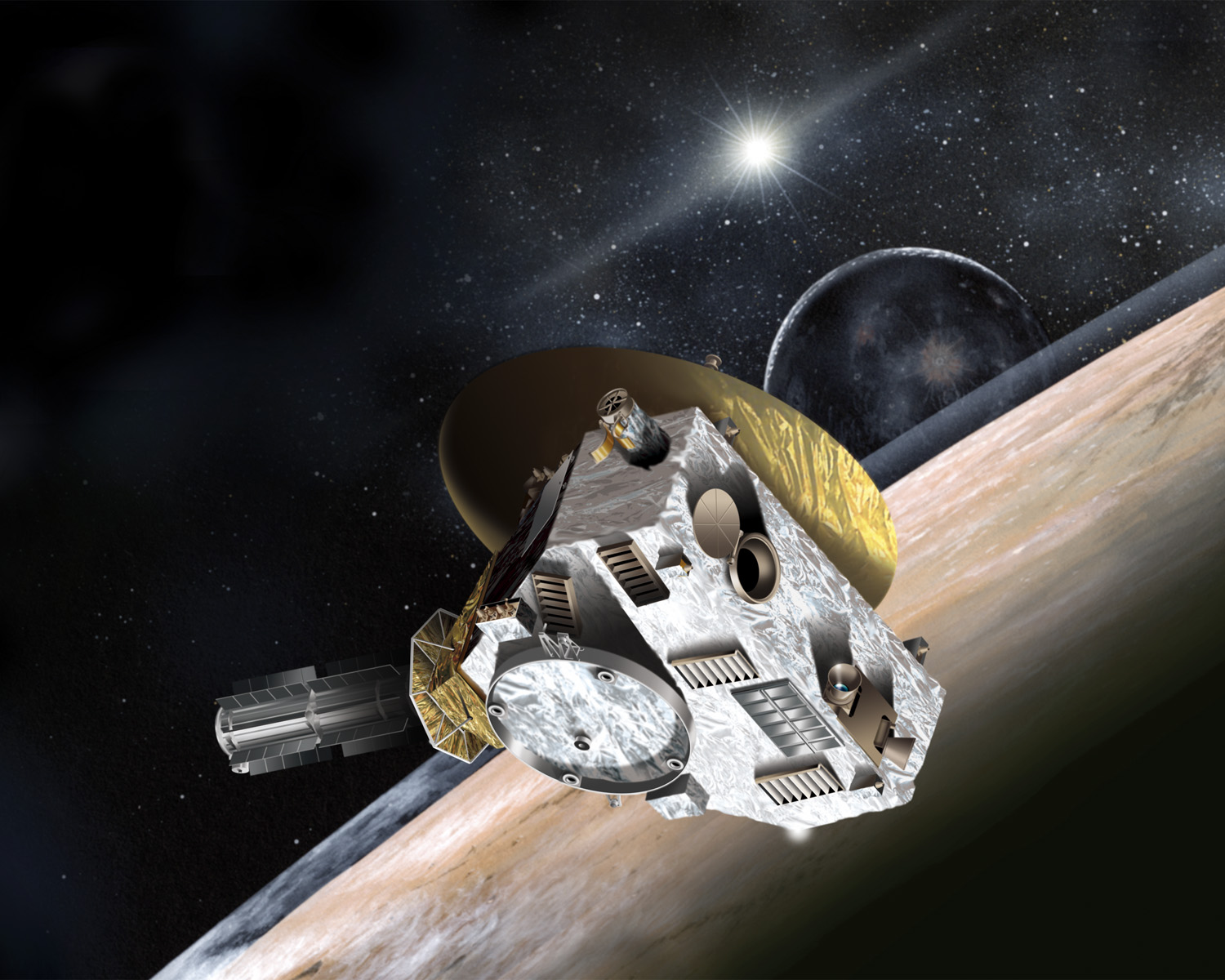
On the planner for Monday January 19, 2006 is a reminder of the fact that that is the date of the launch of the New Horizons Spacecraft that is destined to the be conveyor of our first real data about Pluto. After 9 years of travel through the solar system the spacecraft has begun its long awaited encounter with Pluto that will culminate in a fly-by on July 14 of the dwarf planet that lies 4.67 billion miles away from Earth.

List of space dates for Monday January 19
Now personally, I think that studying Pluto would be a slightly non-fulfilling job because it takes so long for spacecraft to get there. Think about it, when New Horizons launched, Pluto was still a full blown planet and had yet to be reclassified. If you really want to have things put in perspective, the iPhone wasn’t even a thing yet. We were still in the age of iPods with the clicking wheels (solitaire took forever!).

Artist's rendering of fly-by
Courtesy of nasa.gov
But those nine years of waiting are all going to be worth it starting January 25th, when the probe will commence a long range photo shoot of the dwarf planet. After 9 years of hibernation, the fastest spacecraft ever made has finally awoken in preparation for this historic moment. This photo shoot will mark the start of the first real collection of data about Pluto and its nearby moons. This data will, hopefully, provide valuable new insight into the makeup of Pluto and perhaps into the history of dwarf planets. It will also provide useful data in the effort to pinpoint the exact location of Pluto. Stay tuned for more on the data collected and the implications of it!

Sunday, January 11, 2015

Space Travel? YES. Affordable? Um.....YES!


Do you know how much it costs to send one pound of weight into space? Take a guess.
$100?
Not even close
$500?
Nope,
Alright? Maybe $1000?
Still off by a factor of ten
It costs $10,000 to send one pound into space!

Now if you really think about it that is a lot of money and material that gets used just for one launch. After all, you have to launch the entire first stage of the rocket that just gets burnt up in the atmosphere or dropped in the ocean. That is many $10,000 pounds that are only good for one launch. 

However, SpaceX is trying to change all that. They are the California based company started by Elon Musk that are responsible for the Dragon capsules that have completed five successful resupply missions for the ISS. 

On their latest mission to the ISS they tried something new: they tried to land the first stage of the Falcon rocket on a platform in the ocean so that it could be reused. Unfortunately there is no good video of the landing but Elon Musk's tweet sums up the situation well:

"Didn't get good landing/impact video. Pitch dark and foggy. Will piece it together from telemetry and ...actual pieces."
Autonomous spaceport drone ship
SpaceX Landing Platform just off the Cape
Courtesy of BBC.com
The landing was hard and caused damage to the platform and the ship itself. However, it is important to remember that in space exploration every new attempt is a success because of what is learned from it. 

This attempt to land undoubtedly taught SpaceX a lot of what they need to know in order to successfully complete the landing another time. Now improvements can be made and hopefully a future mission to land will be a success. 

Working technology to land the first stage of a rocket represents a whole new era in exploration that is marked by much more affordable and sustainable space travel. Right now space travel is a very costly (and worthwhile) venture and a more affordable way of going into space may be able to convince more people (especially more politicians) of the benefits and necessity of space travel. 

Thursday, April 18, 2013

Spring Has Sprung, The Rockets Are Flying

The grass is turning green. The flowers are coming up. Core testing is starting. We all know what that means, spring is in the here! There are lots of reasons to be excited for spring. It means that school is almost out, it’s time for shorts and dress and skirts again and spring also means that those of us who are space fans can launch our model rockets!

I was first introduced to model rockets last summer. I launched my first one last August. The first step was assembly. It was really fun to see how all the pieces went together to make a rocket. The next part, and what I think is the best part, was launching the rocket. I was super astonished by this particular rocket which went up 1025 feet in the air. It was super cool and amazing! It went all the way up into a cloud! 
My friend and I launching my first rocket!
I’m super excited for spring this year because I get to launch a rocket that I got for my birthday. It’s super cool because it has two accompanying space shuttles that fly off it after lift off. It won’t go quite as high because it is bigger and heavier but it should still be really cool. 

My rocket that is ready for launch!
I also have a really cool rocket that is designed so that instead of parachuting down it will use a built-in helicopter rotor to slowly descend. I still have to build that one. Then I can have a rocket launching day where I launch multiple rockets, multiple times! What fun!
My rocket collection!
In other rocket related news the Antares rocket is set for launch tomorrow. It is a significant launch because the Antares rocket will be the second completely privately made rocket are those made by SpaceX.

I hope that you all have a wonderful spring! If you feel so inclined you can purchase high-quality model rockets here.

Friday, March 29, 2013

Star Trek vs. Science

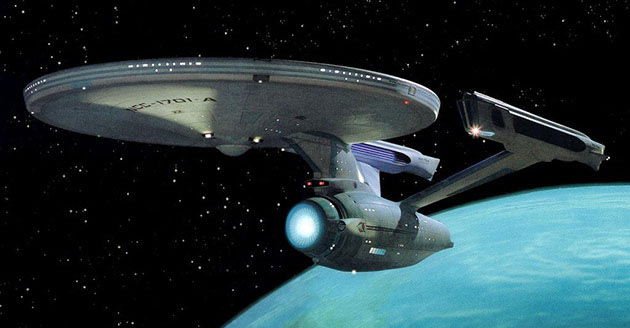
Star Trek Enterprise
Photo Courtesy of news.yahoo.com

Announcing the battle of the eon! It’s the devices and physics in Star Trek versus the hard, facts of science. Who will win? Well, the science battle of a lifetime is coming up next. I am about to pit the devices and concepts of Star Trek 

against the realities of science. Up first....


The Tricoder


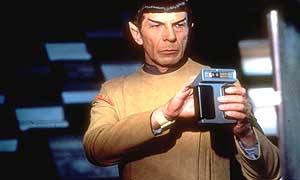
Spock with tricorder
Photo Courtesy of guardian.co.uk
In Star Trek the doctor and other members of the landing parties would often carry a device called a tricorder. A tricorder is a device that when scanned over a person’s body can tell you all about their vital signs and chemical composition. It can also tell various features about the surrounding landscape.

                                                                 Versus 

Science

The tricorder has a lot of potential. There are lots people who think that a device similar to a tricorder is the the future of healthcare. Because of the popularity of the concept there are lots of people who are aiming to create one. The X-Prize Foundation is offering prizes totaling 12.5 million for a functioning tricorder. Also there is the Tricorder Project. The Tricorder Project was started by a man named Peter Jansen. He designed a device similar to the tricorder and then gave the instructions out to the public so that all could make one. Overall, the tricorder holds lots of promise for the medical world and is a pretty realistic concept.


Warp Drive

In Star Trek whenever they need to travel far distances across space the captain will command that the warp drive be engaged. They then speed across the universe faster than the speed of light.

                                                                  Versus 

Science

Many of you are probably thinking that there is no way warp drive could ever be possible. You may just be wrong. There are many physicists who are working on a way to bend the fabric of space-time and move faster than the speed of light. They propose using a device that the astronauts would sit inside that would create a bubble in space-time. 

Proposed space "bubble"
Photo Courtesy of space.com

The astronauts inside the bubble would not feel anything different. The space in front of the ship would be expanding and the part in back contracting which would move the ship forward. So even though warp drive is currently theoretical it could become an actuality.

And the winner is.....well, really neither science nor Star Trek can win this battle. What can be said is that the future of space travel holds wonderful possibilities and the devices from Star Trek may be very helpful along the way. We can also say that when Gene Rodenberry created Star Trek he was very creative but also surprisingly realistic. I bid you farewell today with the classic Star Trek goodbye.

Live long and prosper

Friday, February 8, 2013

Chimps in Space!

Today is Friday so that means another blog post is in order. It’s snowing outside and I’m curled up getting ready to watch one of my all-time favorite movies, Race to Space. The movie is a fictionalized version of the story of Ham the Astro-chimp, the first chimpanzee in space from the US. I thought that perhaps you might enjoy hearing about the story of Ham and a short summary of the movie, so that if some cold winter night you are in need of a good movie you will have a great one.

Ham

Ham getting ready for his flight
Courtesy ofcr.nps.gov
Ham was born in 1956. He was part of a group of sixty chimps that were part of a testing group to find one to send to space. He trained for his flight to space at the Holloman Aerospace Medical Center in New Mexico. That is where he got his name (Holloman Aerospace Medical). Ham was a part of Project Mercury which was a part of the proceedings of the Cold War in which the US was determined to get a human in orbit before the Soviet Union.

Mercury-Redstone rocket like what Ham flew on
Courtesy of nasa.gov
Ham flew on a Redstone rocket, which was designed just for Project Mercury. His successful mission was a reason as to why Alan Shepard was then able to become the first United States citizen in space. To learn more about Ham click here.

Race to Space

My beloved copy of the movie
Photo by me
Race To Space is an adaptation of the story of Ham’s journey to space and back. Instead of Ham, the chimpanzee is named Mac. Mac lives in at the NASA base in Cape Canaveral, Florida. He is being trained by Dr. Donni McGuiness (Annabeth Gish). Billy Von Huber (Alex Linz) is living in Florida with his dad, Wilhelm Von Huber, (James Woods) who is a German rocket scientist working on Project Mercury. Billy develops a close relationship with Mac after he begins to help with his training. Soon though, Billy uncovers a sinister plot set to ruin the project. I don’t want to ruin the ending for you, so I am just going to say that it is very, very good. It’s also very, very funny and very, very, VERY, much worth renting or, dare I say it, buying.

Also, to you music lovers out there, the soundtrack for the movie is absolutely amazing! After hearing it while I watch the movie I always feel like I could go out and do ANYTHING!

Here is a link to the trailer of the movie: 

So, if you are ever in need of a good family movie to watch and you want to learn more about Ham and the first trips to space, just watch Race to Space. It will work for science geeks, music lovers, people who love to laugh, and those who just want a nice heartfelt movie.