Pages

Showing posts with label Announcements. Show all posts

Sunday, March 15, 2015

An Irrationally Wonderful Day

Pi Day
Courtesy of geocaching.com
Happy Pi Day to all the geeks and nerds of the world!  (I know I am one day late). On March 15, 2015  at 9:26 and 53 seconds, an amazing thing happened: the digits of the time matched the first ten digits of pi. Every year on March 14 the mathematicians of the world unite to celebrate Pi Day but yesterday was of particular significance. Usually only three digits match, but once every century ten of them do. This once in a lifetime day led to much celebration for the nerds of the world. It's fun to celebrate such an important number and it is a good excuse to eat lots of pie. Yum! Pi is a particularly interesting and important number for many reasons. I will not go into the intricacies of the number but if you are interested click here. If you are like me and you have a vast collection of nerdy math and science shirts then you probably will want one in commemoration of Pi Day too. I got mine here and had lots of fun explaining it to people throughout the day.

Here are some of my favorite facts about pi and Pi Day:

Sunday, January 18, 2015

New Horizons Reaches a New Horizon

My planner (the best one for any space nerd)

Today I was looking at my planner in preparation for the next week and I found something that made me think. First of all, you need to know that my planner is not just a normal planner; it is a planner that is published by Year in Space in cooperation with the Planetary Society (Buy yours here). What makes it special is that it has space themed pictures for each week and every day lists the special events that have happened in the history of space exploration on that day.

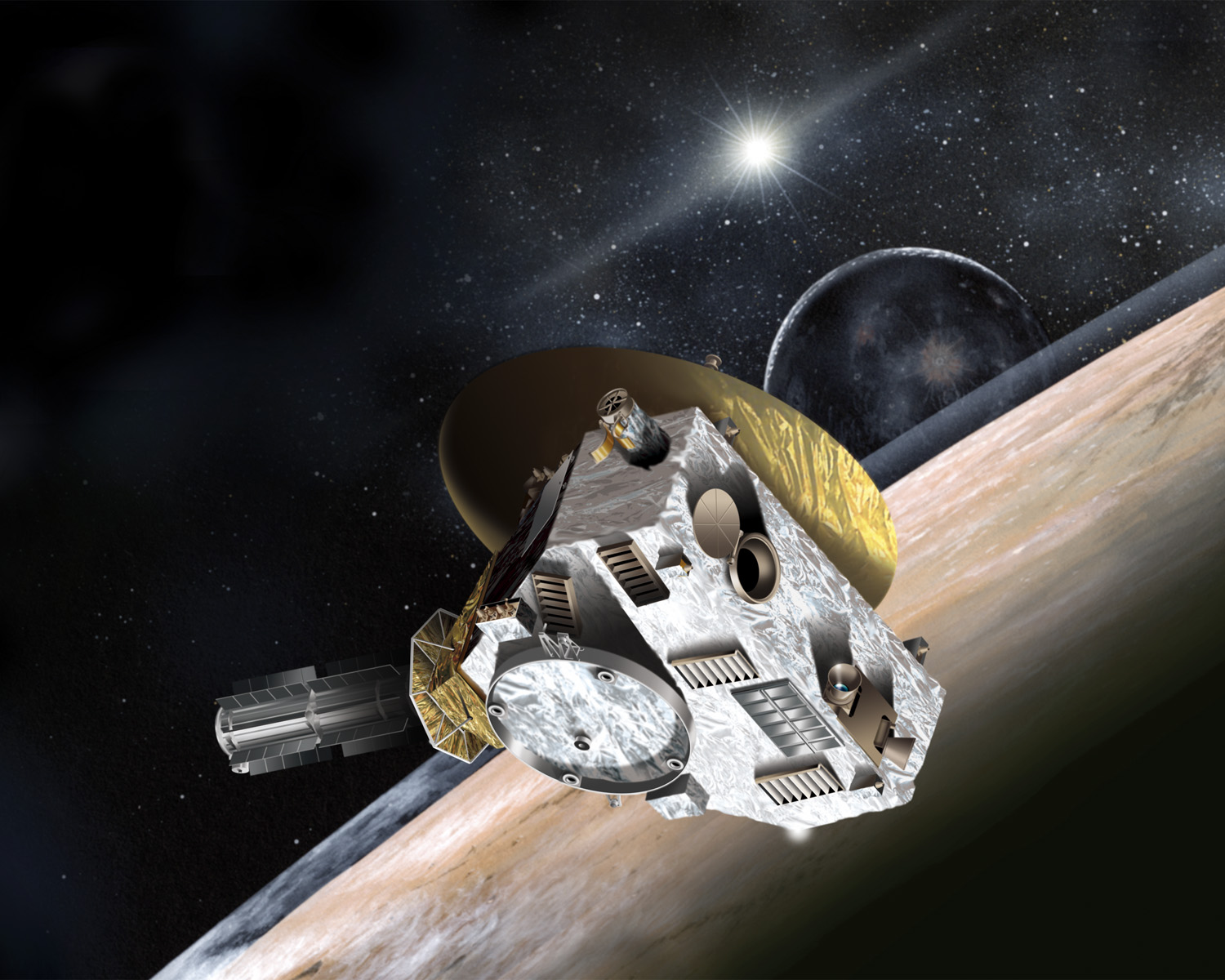
On the planner for Monday January 19, 2006 is a reminder of the fact that that is the date of the launch of the New Horizons Spacecraft that is destined to the be conveyor of our first real data about Pluto. After 9 years of travel through the solar system the spacecraft has begun its long awaited encounter with Pluto that will culminate in a fly-by on July 14 of the dwarf planet that lies 4.67 billion miles away from Earth.

List of space dates for Monday January 19
Now personally, I think that studying Pluto would be a slightly non-fulfilling job because it takes so long for spacecraft to get there. Think about it, when New Horizons launched, Pluto was still a full blown planet and had yet to be reclassified. If you really want to have things put in perspective, the iPhone wasn’t even a thing yet. We were still in the age of iPods with the clicking wheels (solitaire took forever!).

Artist's rendering of fly-by
Courtesy of nasa.gov
But those nine years of waiting are all going to be worth it starting January 25th, when the probe will commence a long range photo shoot of the dwarf planet. After 9 years of hibernation, the fastest spacecraft ever made has finally awoken in preparation for this historic moment. This photo shoot will mark the start of the first real collection of data about Pluto and its nearby moons. This data will, hopefully, provide valuable new insight into the makeup of Pluto and perhaps into the history of dwarf planets. It will also provide useful data in the effort to pinpoint the exact location of Pluto. Stay tuned for more on the data collected and the implications of it!

Saturday, January 3, 2015

Happy Perihelion!

Courtesy of nasa.gov
Tonight marks the point when the earth is closest to the sun. This is called perihelion from the Greek peri meaning near and hellos meaning sun. The moment this happens is at 06:36 UTC Jan. 4, 2015. That translates to 01:36 Eastern US time, or 10:36 p.m. Pacific time on Jan. 3 so technically it is tomorrow for part of the world but for us here in the Western US it is tonight (living on a sphere causes weird things to happen with time). 

As a moon orbits its planet, the planet moves, too.
Courtesy of nasa.gov
The earth orbits the sun in an elliptical path so our distance from the sun is always changing. If we orbited in a perfect circle, our average distance would never change. However, because the moon orbits the earth we actually move a little bit each day. You see, the moon is orbiting the earth but technically they are orbiting a common center of gravity (see animation).

Now perihelion is an interesting phenomena because it, when explained, debunks the myth that seasons happen because of the planet's distance from the sun. After all, it is winter in the Northern Hemisphere and yet we are as close to the sun as we get. Now the aforementioned myth is also easily debunked because it stems from Eurocentric or Northern Hemisphere-centric views. A lot of people forget that while it is winter in the Northern Hemisphere it is summer down south, so that myth does not hold up to logic. 

So as we approach perihelion remember how incredible it is that you are on a planet that is revolving around a star that is one of approximately 100 billion other stars in our galaxy. Puts things in perspective doesn't it?

I bid you a happy perihelion!

Wednesday, December 31, 2014

2014: The Space Year in Review

As 2014 comes to a close I invite you to join me in looking back over the most important things that happened in space exploration this year. Between the launch of Orion, the discovery of exoplanets,
and the landing of  a probe on a comet, it has been a busy year for space exploration!

Orion:
Orion Launch
Courtesy of  abcnews.com
On December 5, 2014 the Orion Space Capsule launched aboard a Delta IV Heavy Rocket from Cape Canaveral. It is a historic moment because it marks the start of the return of US based human space exploration. Orion is the capsule designed to send humans farther into space than ever before. It is planned to go to an asteroid and eventually to Mars. Missions like Orion will serve to reinvigorate the spirit for space exploration in the US and in the world.


Kepler:
Courtesy of wikipedia.com
This year the Kepler space telescope (read my post about it here) discovered 715 exoplanets. This is more planets than have ever been discovered. The discoveries serve to provide a goal for future space exploration: that someday we might visit on one of them. It also reminds everyone how incredible it is that we have life here and earth and sparks curiosity about whether life may exist on any of the countless exoplanets, both discovered and unknown.


Cosmos:
Courtesy of nerdist.com
This spring a revival of Carl Sagan's Cosmos: A Personal Voyage aired with a new title, new episodes and a new host. Even though this was not an event in space it is worthy of this list because it shared the wonders of space with over 400 million people in 60 different countries. It was hosted by Neil DeGrasse Tyson and it was amazing! If you did not get a chance to watch it on tv I highly recommend you take the time to watch it on Netflix, iTunes or Amazon; it will be time well spent.


Rosetta:
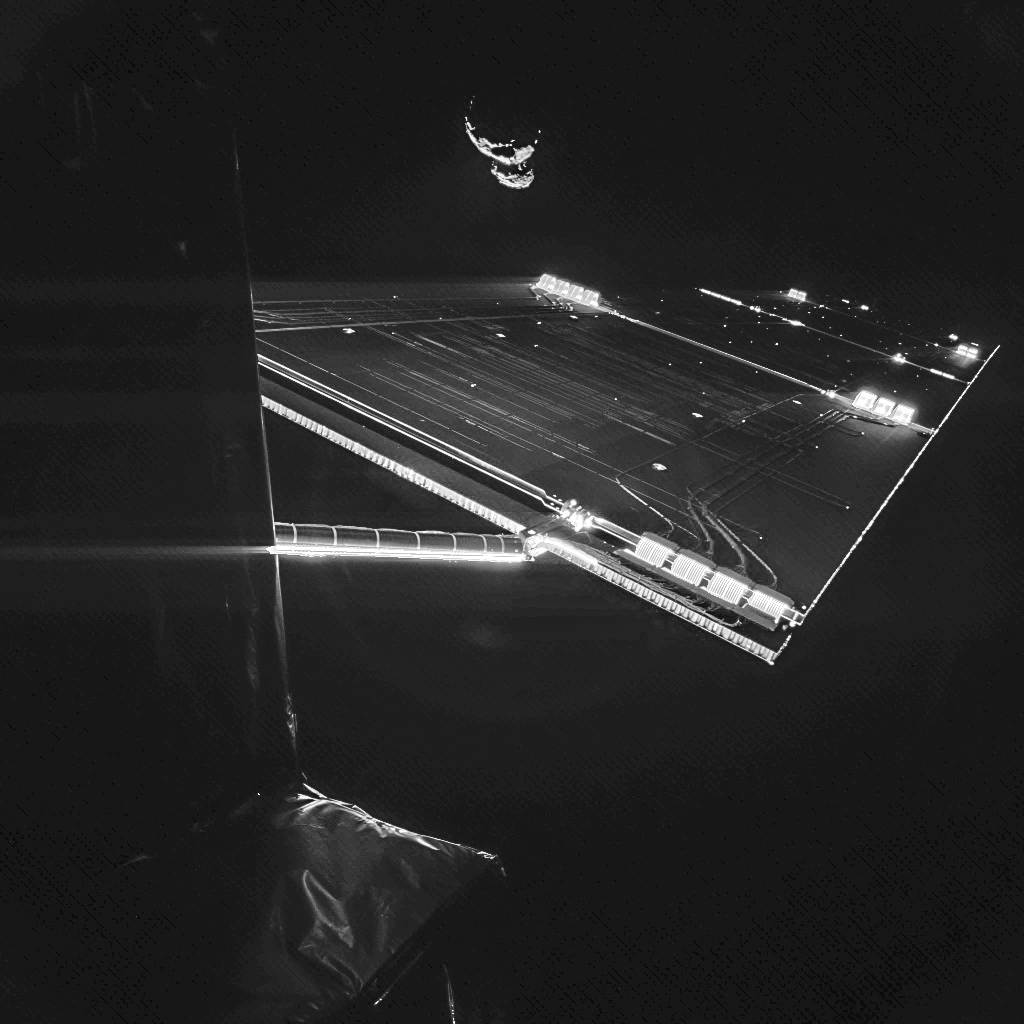
Rosetta's Selfie
Courtesy of esa.int
On November 12, 2014 the European Space Agency successfully landed a probe on Comet 67P/Churyumov-Gerasimenko (Don't worry, I can't pronounce that either). This in itself was a huge success that came after 10 years of travel by the spacecraft. It sent back lots of information about the comet along with pictures that are, to scientists, gold because they, for the first time ever, show what the surface of a comet actually looks like.

Unfortunately, the probe bounced and landed upside down in a crevice. While that is a problem as it cannot get power when it is in the dark, the mission was still a success. Landing on the comet was a huge leap for human space exploration and marks the start of a new era of exploration of comets and asteroids.


So, as you can see, a lot happened in space exploration this year. We learned a lot and had many successes. Let us hope that we can learn and explore even more in 2015!

Friday, December 14, 2012

Go Find A Star!


ATTENTION!

Do you want to help find planets in the Andromeda galaxy? If you do go to this link www.andromedaproject.org. Researchers are trying to find out more about the Andromeda galaxy because some day in the very distant future the Milky Way and Andromeda will collide and merge. The goal is identify the thousands of star clusters that are in the pictures taken by the Hubble telescope of the Andromeda galaxy. This is a fun easy thing to do. Just spend 5-10 minutes looking through the pictures and circling and you can walk away knowing that you have helped scientists tremendously!


Thanks so much!