Pages

Showing posts with label Planets. Show all posts

Sunday, January 18, 2015

New Horizons Reaches a New Horizon

My planner (the best one for any space nerd)

Today I was looking at my planner in preparation for the next week and I found something that made me think. First of all, you need to know that my planner is not just a normal planner; it is a planner that is published by Year in Space in cooperation with the Planetary Society (Buy yours here). What makes it special is that it has space themed pictures for each week and every day lists the special events that have happened in the history of space exploration on that day.

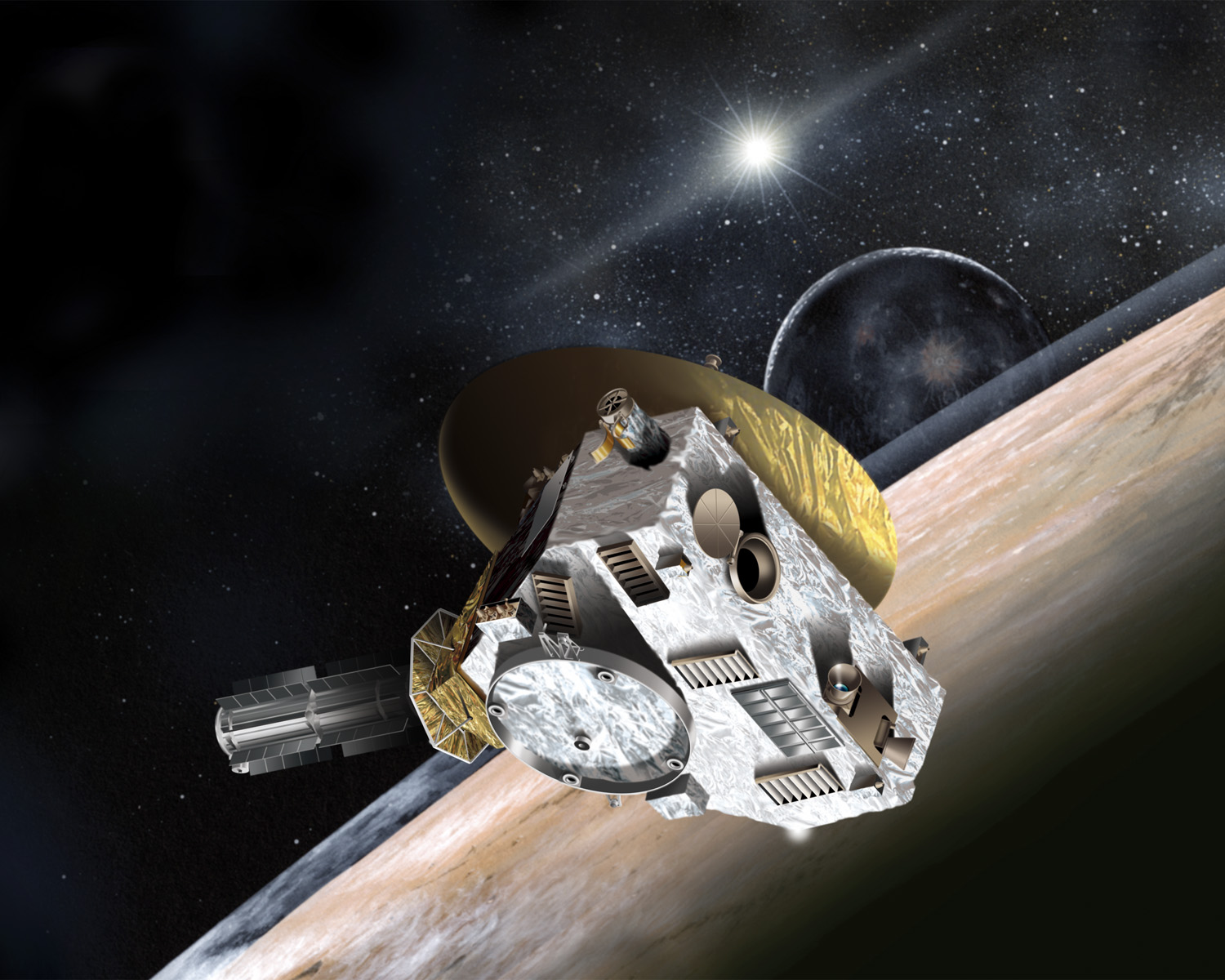
On the planner for Monday January 19, 2006 is a reminder of the fact that that is the date of the launch of the New Horizons Spacecraft that is destined to the be conveyor of our first real data about Pluto. After 9 years of travel through the solar system the spacecraft has begun its long awaited encounter with Pluto that will culminate in a fly-by on July 14 of the dwarf planet that lies 4.67 billion miles away from Earth.

List of space dates for Monday January 19
Now personally, I think that studying Pluto would be a slightly non-fulfilling job because it takes so long for spacecraft to get there. Think about it, when New Horizons launched, Pluto was still a full blown planet and had yet to be reclassified. If you really want to have things put in perspective, the iPhone wasn’t even a thing yet. We were still in the age of iPods with the clicking wheels (solitaire took forever!).

Artist's rendering of fly-by
Courtesy of nasa.gov
But those nine years of waiting are all going to be worth it starting January 25th, when the probe will commence a long range photo shoot of the dwarf planet. After 9 years of hibernation, the fastest spacecraft ever made has finally awoken in preparation for this historic moment. This photo shoot will mark the start of the first real collection of data about Pluto and its nearby moons. This data will, hopefully, provide valuable new insight into the makeup of Pluto and perhaps into the history of dwarf planets. It will also provide useful data in the effort to pinpoint the exact location of Pluto. Stay tuned for more on the data collected and the implications of it!

Friday, May 10, 2013

A One Way Trip To Mars? No Thanks


There are 78,000 people applying to be aboard a one way trip to Mars. The trip is sponsored by the a group called Mars One. Their goal is to put a permanent human settlement on Mars. They want the first four people to be on Mars by 2023.

For me personally I think this project is not a very good idea. I think that while the populous should be involved in space exploration we need to leave the engineering and carrying out of the projects to space agencies who have experience and protocol. 

From the start of space exploration our space agencies around the world have learned what needs to be done to keep human life safe in space. Also, we have protocol for not bringing things such as viruses and bacteria from Earth out into space. From the moment a human sets foot on Mars it will be contaminated and could potentially kill any forms of life that may exist there.I also think that the space exploration should be a public and publicly funded endeavor. It needs to be of the people. Private enterprise is great for some things but not space exploration.

Proposed Mars Colony
Courtesy of space.com
Another obvious fault with the plans of Mars One is the why. Our robotic technology gets better everyday. So why spend over four billion dollars to put a human on Mars and endanger their life and potential extraterrestrial life forms? A robot can do scientific observation faster and more effectively than a human when it comes to researching Mars. I’m not saying the spark of human curiosity is not extremely valuable. I’m saying that for right now robots are the way to go.

Also, Mars is a very toxic environment for a human. One little error can cause drastic failure and death. Until we have a really good reason to put humans on Mars and until we have a way to bring them home let’s wait. 

Overall I admire the initiative of Mars One but I don’t think it is the way to go right now.

So then I must ask, what do you think?

Thursday, January 31, 2013

I Became A Citizen of Mars Today

I know, I know, you’re saying, “What? She can’t become a citizen on Mars. What is going on here? This is craziness!”

I promise you, I am not crazy. I did in fact become a Martian today. I did so via an online program called Be A Martian which is run by NASA’s Jet Propulsion Laboratory. It is a game of sorts where you make a profile as a Martian citizen and then get to travel all over Mars. The purpose of the game is to have the Martian “citizens” look at pictures taken by the rovers Spirit and Opportunity as well as by the Mars Odyssey Orbiter and the Mars Global Surveyor Orbiter.  The participants help to count the craters, align the photos, and tag the images based on what is seen.

The pictures provided by the orbiters and rovers sum up to a jumble of images from all over the surface of Mars with no easy way to organize them. That is why this program is so cool. It provides a fun way to look at Mars and but is also productive. Believe me, it is hard to find a computer game that can be deemed productive but this one is. 

Courtesy of http://beamartian.jpl.nasa.gov/

This profile is the first thing I created as I became a citizen of Mars. I got to pick what kind of citizen I was going to be. As you can see I picked “Life-long Learner” because I think that knowledge is power and I enjoy learning.

The next thing I did after becoming a Martian was to attempt to map Mars.

Courtesy of http://beamartian.jpl.nasa.gov/

To do so I looked at the grayscale picture and the color picture presented to me. Each was taken by one of NASA’s exploring devices. My job was to align the images so that things like craters and rocks line up. That way NASA then compiles the images processed by thousands of people to create a comprehensive map of Mars.

Following my mapping expedition I tried counting craters.

Courtesy of http://beamartian.jpl.nasa.gov/

It turned out that counting craters is a very simple job. All I had to do was click on each crater in the image and size the circle to match the size of the crater. This way NASA can know how many craters are where and use that information to learn about Mars.

My final project of the day was to tag images.

Courtesy of http://beamartian.jpl.nasa.gov/
An image would be given to me on the screen and I would look over it. Next, I would select the categories on the side and pick the tags representing what I saw in the picture. (Look at the image above if this isn’t making sense).

Whew! What an exhausting first day on Mars. It was, however, a very productive day. Look at all the badges I earned! 

If you would like to become a Mars Citizen visit: http://beamartian.jpl.nasa.gov/welcome

I hope you have lots of fun experimenting with the perks of being a Martian. Have a great day!

Thursday, January 3, 2013

2012: The Space Year in Review


Before we dive into 2013 I think it is important to look back at all the amazing accomplishments that have occurred in 2012. This year has been a big one for discoveries in space and one full of milestones regarding people and ships who have traveled there. There have been well-known astronauts who passed away, new rovers sent out to discover, and new companies pushing the boundaries of space.


Photo Courtesy of nasa.gov
Neil Armstrong

August 5, 1930- August 25, 2012

This year the nation and world were saddened to hear that Neil Armstrong had passed away. Neil Armstrong was the first human being to ever touch another planet while in space. He is most well known for his quote, “One small step for a man, one giant leap for mankind.” Throughout his life he pushed barriers and inspired other people to reach for the stars.


Photo Courtesy of nasa.gov
Curiosity Rover

On August 6, 2012 the Curiosity rover touched down on Mars. This was a game changing event for the United States and the entire world since the Curiosity rover carries the most advanced scientific research tools ever present on Martian soil. The discoveries that it has made and the discoveries that it will make are and will be influential for the future of space flight.

If you are interested in learning more about the Curiosity rover click here.


Photo Courtesy of wikipedia.org
Sally Ride

May 26, 1951- July 23, 2012

The world was saddened this year when they had to say goodbye to Sally K. Ride. She was the first female astronaut in space. Sally Ride lead the way for young women who were/are interested in going into space. She had a Ph.D. in physics and was inducted into the National Women’s Hall of Fame and the Astronaut’s Hall of Fame. Sally Ride will never be forgotten for the barriers she broke down and the doors she opened up.


Photo Courtesy of wikipedia.org
SpaceX

This year SpaceX became the first commercial company to send their own space vehicle to the International Space Station. It sent its second Dragon capsule to the ISS where it docked and gave the station supplies. This is/was big news because it opens up space travel to private companies. That can mean that in the near future there will be  trips to space for the non-astronaut person and eventually even hotels and colonies.


I have already done a post about the Curiosity rover but intend to do individual posts about each of these topics so keep checking the blog for the latest posts!

Also, I would love to here what you want to see a post about! As long as it has to do with space I would be happy to try. If you have an idea leave it in the comments and I will try my hardest to do one a post about it.

Friday, December 14, 2012

All About Kepler


Have you ever heard of William Borucki? I hadn’t until I read the latest issue of Discover magazine. They had a whole article dedicated to him and his project. William is the man behind Kepler. Kepler is the planet-finding telescope that is looking for Earth-like worlds within the Milky Way galaxy. As you probably know already from my other posts, I like the idea of finding other Earth-like planets because they have the potential for life. That is why this article was really interesting to me. 

The story talks about how since the launch in 2009 Kepler has found over 3,000 potential planets and counting. This is super amazing because if Kepler learns of many Earth-like planets then the possibility for life in the galaxy will increase exponentially. Kepler is special because since it is out in space it can gather more information than telescopes here on Earth. That is because it doesn’t have to contend with the atmosphere and other interferences.

After reading the article I decided to learn more about Kepler so I went to NASA’s page for it and learned that recently an extension of the mission got approved. This is great news because it means that more planets can be found! 
Kepler Telescope
Photo Courtesy of www. nasa.gov
I also learned how the telescope works. It uses an ultra sensitive ultraviolet sensor to pick up on the potential planets. It measures the brightness of more than 100,000 stars without stopping. The brightness of a star can predict the presence of planet because when a planet in orbit crosses in front of a star it changes the amount of light. If Kepler picks of changes in the amount of light on a regular basis then that is reason to believe that a planet is orbiting that star. If you want to know more about how the Kepler telescope works by looking at some interactives click here.

Projects like this one are so amazing because they help to discover what is out there and around us. Kepler in particular is cool because it is finding Earth-like planets that are in our galaxy. I hope that no matter what happens here on Earth we NEVER lose our curiosity for what is out there to be discovered! Curiosity is what drives science forward and I hope that will never end.

Friday, November 30, 2012

Curious About Curiosity

I'm sure you have all heard about the Mars Science Laboratory better known as the Curiosity Rover. Perhaps you even remember Spirit and Opportunity and the time when they headed to Mars and changed the history of space exploration. I remember how when I was a little girl my dad and I would play a game on the NASA website with the Spirit and Opportunity rovers.  In the game we would put the materials needed for the mission onto the rovers and then launch them to Mars. The game was really fun for me because I was able to think about going to another planet and exploring it. Who wouldn't think that was cool?!


That's why I was so excited to hear about the Curiosity rover earlier this year. After all these years of innovation and creativity the Curiosity rover can do things that would never have been dreamed of back when space exploration first began. Now we can delve deeper into the past life of Mars and maybe find evidence of life.

Curiosity made a big mark on the history of space exploration just by landing. The landing of the Curiosity rover was so unique because it was a technique that had never been tried before. The previous ways of landing that had been used on Spirit and Opportunity wouldn't work for Curiosity because the weight of the rovers was so different.

Scientists had to brainstorm a new way to land. They came up with a thing called a sky crane. The sky crane is essentially a parachute and thrusters. The trick to it was that there was no way to test this landing process for real before the actual thing. In order for it to work the parachute had to deploy perfectly to position the rover EXACTLY perpendicular to Mars' surface. Then the thrusters had to come on and land the rover gently.
MSL Landing
Photo Courtesy of NASA.gov

The most recent accomplishment was when Curiosity completed the first ever deep analysis of a soil sample on Mars. The way the rover is designed a "hand" can pick up a soil sample and insert it into the belly of the rover. There the sample undergoes various tests including analysis of the chemistry of the sample and looking at the mass spectrometry of the sample.
 Five spots where Curiosity has scooped soil from
Photo Courtesy of NASA.gov

Curiosity is quite literally a high tech science lab on wheels that can do so much in the search for evidence of past life on Mars. What the rover may find about the composition of Mars will dramatically effect what the Earth's future looks like. If something resembling life was found....it would be game changing. I don't want to act like I know how something that amazing would change our future but the change would be BIG! I am confident that Curiosity will find lots of information that will change the way we view the universe and I'm so excited for the future it holds.

Friday, October 26, 2012

A Next Door Neighbor


Earth.

Home to seven billion people.

Unique in size to all the other planets.

All alone.

Wait! What do you mean it now has a neighbor?

An Artist's Rendition of the New Planet.
Photo Courtesy of Nytimes.com
That’s right. On Wednesday of this week a team of European astronomers announced the discovery of a new planet. Great, another planet to learn about. Go stick it on the shelf next to ALL the other new planets. However, this planet is special. It is Earth-sized and relatively speaking, very close to us. It lies in the orbit of Alpha Centauri which is the closest star to us. Only 4.3 light years away! (That’s eighty-one thousand years in our fastest spaceship)

Scientists, astronomers, and  astrophysicists all around the world are very excited about this discovery because this new planet, which is currently unnamed, is so close to Earth and is not exponentially smaller or larger than Earth.

Imagine how this could affect us here on Earth. For starters, if there is one there are more. Even though this one is rocky and it’s closeness to Alpha Centauri causes temperatures that are unlivable there most likely are other ones out there that may be the right distance away from their sun that there would be livable conditions. There could even be a planet out there with life on it.

One small planet can make so many differences in our life. There is now discussion of having telescopes focus specifically on that area of the galaxy and, if they find more planets of similar size, sending a probe there!

I was so excited to hear about this because I firmly believe that there is other intelligent life somewhere in our universe and I think that this discovery has sparked new flames to work harder and dig deeper on our way to finding life. I also think that this is such an important discovery simply because of the fact that we were able to see it. The planet is 4.3 LIGHT YEARS away. That is 25,277,000,000,000 miles away. To know that we can find planets that far away and be able to tell things about them like what their surface is made of never fails to astound me. 

This new little planet means the start of a new era of space exploration. A search to find other Earth-like planets. Who knows what this has is store? I sure don’t but I am very excited to find out!